- All
- Product Name
- Product Keyword
- Product Model
- Product Summary
- Product Description
- Multi Field Search
Views: 0 Author: Site Editor Publish Time: 2026-08-08 Origin: Site


I manage the export side of a CNC lathe factory in China. That means I talk to buyers every single day â from Vietnam, Turkey, Brazil, Egypt, Indonesia, you name it. And after 15 years of this, you start to notice patterns. You start to feel which way the wind is blowing before the data shows up in any industry report.
So here's what I'm seeing in our order book right now. Five trends, straight from the front lines. No fluff, no predictions pulled from thin air â just what's actually happening with real orders going out our door.
Five years ago, the Middle East and South America were roughly tied for our top export regions. Not anymore. In 2025, Southeast Asia accounted for about 40% of our total export volume. In the first half of 2026? Closer to 45%.
Vietnam alone takes more machines than any single country we ship to. Thailand and Indonesia aren't far behind. And the interesting thing is the type of machines they're buying.
Vietnamese shops tend to start with horizontal lathes â the CK6 series is by far our bestseller there. The CK6140 and CK6150 specifically. These buyers are doing general-purpose turning: shafts, bushings, flanges, simple automotive parts. They need reliability and fast delivery more than they need exotic specs.
Thai buyers, on the other hand, are increasingly spec'ing larger machines. We've shipped several CK6180 and CK61100 units to Thai automotive suppliers in the past year alone. Indonesia is a mixed bag â lots of smaller job shops buying entry-level machines, but a growing number of medium-sized factories upgrading from manual to CNC.
The pattern is clear: Southeast Asian manufacturing is climbing the value chain in real time, and CNC lathe orders are a reliable leading indicator of that shift.
Two years ago, maybe 10% of our buyers would ask about automation compatibility. Now it's closer to 35%. They want bar feeders, chip conveyors, probe interfaces, remote monitoring ports â the works.
Here's the funny part: when we follow up six months later, roughly half of those buyers haven't installed any automation at all. The robot or bar feeder they were planning? Still on the "someday" list.
But they still wanted the machine to be ready for it. And honestly, I think this is smart thinking. When you're buying a CNC lathe in 2026, you should absolutely be thinking about how it fits into a future automated cell â even if that cell is two or three years away.
What does "automation-ready" actually mean in practice? A few things:
Standardized machine interfaces â the ability to connect external bar feeders or part catchers without custom fabrication
Signal I/O ports â so a robot arm can know when a cycle is complete
Chip management â automated chip conveyors become essential when nobody's standing at the machine
Network connectivity â Ethernet or WiFi for remote monitoring, even if just through a simple dashboard
The machines that ship with these features cost maybe 5-8% more upfront. But retrofitting them later? That can run 20% or more, if it's even possible on older control systems.
If I had to estimate, Fanuc is in maybe 55-60% of the machines we build. That's down from 70% five years ago. Not a collapse â but a clear trend.
Who's taking share? A few players:
Siemens has gained ground in markets where buyers are doing complex contouring â think impellers, turbine blades, anything with tight 3D profiles. The Siemens 828D and 840D handle that stuff beautifully. We wrote a detailed comparison of Fanuc vs Siemens last month if you want the full breakdown.
Mitsubishi is quietly growing, especially in Southeast Asia. Japanese buyers in Thailand tend to request it. And some Southeast Asian shops that already have Mitsubishi-controlled machining centers want consistency across their floor.
Chinese domestic controls â brands like GSK, KND, and HNC â are the real story. Five years ago, international buyers wouldn't touch them. Now, a surprising number are willing to try, especially for simpler turning work. The price difference is significant â sometimes 30-40% less than Fanuc for the control alone.
My honest take? For high-precision or high-mix work, Fanuc and Siemens are still the safe bets. For production turning with relatively simple geometries â which is what most of our buyers actually do â domestic controls are increasingly viable. The gap between "good enough" and "premium" has narrowed more than most buyers realize.
This one surprised even me. Over the past two years, our vertical lathe orders have grown about 25% year-over-year, while horizontal lathe orders grew maybe 8-10%.
Why? Two reasons:
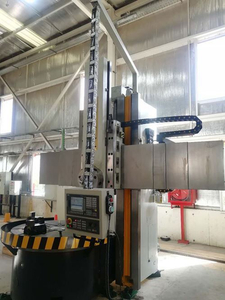
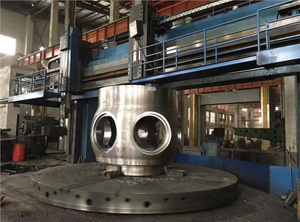
First, workpiece geometry is shifting. More of our customers are machining disc-type and ring-type parts â flanges, gear blanks, bearing races, valve bodies. These parts are naturally better suited to vertical turning because gravity holds the workpiece against the chuck, not the other way around. A heavy disc on a horizontal lathe puts all the weight on the chuck jaws in a way that can cause distortion. On a vertical lathe like the CK5 series, the workpiece sits flat on the table. Problem solved.
Second, floor space is getting more expensive. Vertical lathes have a smaller footprint than horizontal lathes of equivalent swing capacity. In cities like Ho Chi Minh or Bangkok, where factory rent runs $4-6/sqm/month, that footprint difference translates to real money.
I'm not saying vertical lathes will replace horizontal ones â they won't. Long shafts, deep bore work, and bar-fed production turning will always be horizontal territory. But for the growing category of medium-size disc and ring parts, vertical is becoming the default choice for a lot of buyers. And that shift shows no sign of reversing.
Here's something that might seem counterintuitive: the buyers who care least about specs are the fastest-growing group in our customer base.
Let me explain what I mean. Five years ago, most buyers came to us with a spec sheet â tolerance requirements, surface finish grades, spindle speed ranges, the works. They knew exactly what they needed, and they wanted us to meet it.
Today, a growing number of buyers come to us with a part instead of a spec sheet. They'll say: "Here's the part we need to make. What machine do we need?" And after looking at the part, nine times out of ten, we recommend a standard-grade machine. Not because we're trying to upsell them on premium â but because their parts genuinely don't need the highest precision available.
A standard-grade CK6140 holding ±0.01mm and Ra 1.6 can handle 80% of the parts that most small and medium shops actually produce. The ultra-precision machines holding ±0.002mm? Those are for the top 5% of applications â aerospace bearings, medical implants, optical components. Most general machining doesn't need that.
This trend tracks with the broader shift I mentioned in Trend 1. As Southeast Asian, Middle Eastern, and Latin American manufacturing grows, the volume of "good enough" machining is growing even faster. And that's healthy â it means more shops are getting productive with CNC technology instead of over-engineering their purchases.
Stepping back from the five trends, here's what I'd tell anyone looking at a CNC lathe purchase right now:
Don't over-spec your machine. The "good enough" principle is real. Buy for the parts you actually need to make, not the parts you might need to make in three years. If your tolerance requirements are ±0.01mm, don't pay 40% more for ±0.003mm capability.
Think about automation now, even if you're not ready for it. The 5-8% premium for automation-ready features is cheap insurance. You'll be glad you have those interfaces when labor costs keep climbing.
Take vertical lathes seriously. If your parts are disc-shaped, ring-shaped, or under 500mm in diameter with flat mating surfaces, a vertical lathe might give you better results than a horizontal â with a smaller footprint and less workholding hassle.
Don't dismiss the "budget" control options. For standard turning work, domestic Chinese controls have closed the quality gap significantly. The savings are real, and the risk is lower than most buyers assume.
These aren't predictions. They're patterns I'm seeing every week in our order flow, our email inbox, and our shipping schedule. The CNC lathe market is changing â and the buyers who understand where it's heading will make smarter purchasing decisions than the ones who keep buying the same way they did five years ago.
If you're evaluating a CNC lathe right now and want to talk about what makes sense for your specific situation, we're always happy to have that conversation. No pressure, no hard sell â just honest advice from people who build these machines every day.