- All
- Product Name
- Product Keyword
- Product Model
- Product Summary
- Product Description
- Multi Field Search
Views: 0 Author: Site Editor Publish Time: 2026-07-13 Origin: Site


The global shortage of skilled CNC operators has reached critical levels. Industry reports from 2025 show that over 60% of machine shops worldwide struggle to recruit and retain qualified lathe operators. This labor gap directly impacts your bottom line through overtime costs, production bottlenecks, and inconsistent quality from fatigued operators.
Automation solves these problems by:
Running 24/7 unattended â A properly integrated CNC lathe with robotic loading can operate through two to three shifts without human intervention, effectively tripling your output capacity
Eliminating human variability â Robots deliver parts to the chuck with repeatable accuracy of ±0.02mm, removing the natural variation that occurs across an 8-hour shift
Reducing per-part cost by 25-40% â When you spread the fixed cost of the machine over triple the output, your per-part machining cost drops dramatically
Improving workplace safety â Removing operators from direct contact with heavy, hot, or sharp workpieces eliminates a major category of workshop injuries
For buyers evaluating a new CNC vertical lathe manufacturer or horizontal lathe supplier, the automation-ready features of the machine should be a key consideration in your purchasing decision.
Choosing the right automation solution depends on your part family, production volume, and the specific CNC lathe model you operate. Here is a comprehensive breakdown of the most common automation architectures.
Gantry loaders represent the most cost-effective entry point for CNC lathe automation, typically priced between $18,000 and $45,000 per unit from Chinese manufacturers. These systems mount on a frame above or beside the lathe, using linear rails and a pneumatic or servo-driven gripper to transfer parts.
Best suited for:
CK6 series horizontal lathes processing bar stock or chuck parts
Medium-volume production runs (500-50,000 pieces per month)
Parts weighing under 15 kg
Operations with 2-4 different part families
Specification | Standard Gantry | High-Speed Gantry |
|---|---|---|
Load capacity | 5-15 kg | 10-30 kg |
Cycle time | 6-12 seconds | 3-6 seconds |
Axes | 2-3 | 3-4 |
Price range (China) | $18,000-$30,000 | $30,000-$45,000 |
Compatible lathe types | CK6 horizontal | CK5 vertical, CK6 horizontal |
Six-axis articulated robots offer maximum flexibility for complex automation cells. When paired with a CK5 vertical lathe for large-diameter workpieces or a CK6 horizontal lathe for shaft-type parts, these robots can handle parts from 0.5 kg to over 100 kg depending on the model.
Key advantages of robotic arms:
Multi-machine tending â A single robot can service 2-4 CNC lathes, maximizing capital utilization
Complex part handling â Able to orient parts, perform secondary operations like deburring, and place finished parts into specific positions
Quick changeover â Programs for new part numbers can be loaded in minutes, making this ideal for job shops
Price range: $35,000-$120,000 from Chinese manufacturers (including end-of-arm tooling and integration)
For small to medium workshops that need flexible automation without safety fencing, collaborative robots represent an emerging option. These systems work alongside operators and can be manually guided through new part programs.
Cobot advantages for CNC lathe automation:
No safety fencing required (reduces footprint by 30-40%)
Can be redeployed between machines in under 30 minutes
Lower initial investment ($20,000-$55,000 from Chinese suppliers)
Ideal for high-mix, low-volume production environments
Works well with both CK5 vertical and CK6 horizontal lathes
For the highest production volumes, pallet pool systems integrate with CNC lathes through a centralized workpiece management system. Multiple pallets cycle between loading stations and machines, enabling true lights-out manufacturing.
Feature | Small Pallet Pool | Large Pallet Pool |
|---|---|---|
Number of pallets | 4-8 | 12-24 |
Pallet size | 400Ã400mm | 630Ã630mm or larger |
Workpiece weight | Up to 50 kg | Up to 500 kg |
Price (China supplier) | $40,000-$70,000 | $80,000-$180,000 |
Best for | CK6 horizontal lathe | CK5 vertical lathe |
Annual throughput increase | 150-200% | 200-350% |
The physical orientation of your CNC lathe fundamentally changes how automation integrates with the machine. Understanding these differences is critical when you're planning to buy a CNC lathe with automation in mind.
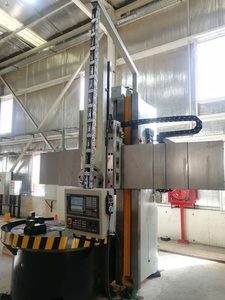
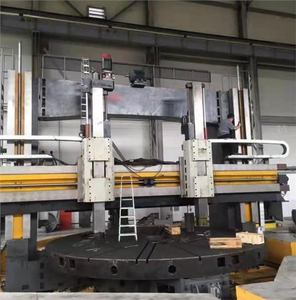
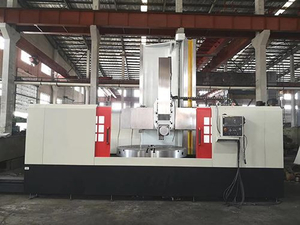
The CK5 vertical lathe's workpiece sits on a horizontal table with the spindle axis vertical. This creates unique automation dynamics:
Gravity assists part loading â Parts are placed onto the table from above, which aligns naturally with robotic top-down placement
Large, heavy workpieces â CK5 machines handle workpieces up to several tons, requiring heavy-duty robotic arms or gantry systems with substantial payload capacity
Chuck/clamping access â The open-top configuration makes it easier for automation to access the workpiece for loading and unloading
Chip management â Chips fall away from the workpiece by gravity, reducing interference with the automation gripper
Recommended automation for CK5 vertical lathes: Heavy-duty gantry loaders, large-payload articulated robots (50+ kg capacity), or overhead crane-integrated systems for very large workpieces.
The CK6 horizontal lathe holds the workpiece between centers or in a chuck with the spindle axis horizontal. Automation here follows different logic:
Radial part access â The gripper must approach the chuck from the front, which constrains the automation layout
Bar feeders are natural partners â For bar work on CK6 machines, an automatic bar feeder ($8,000-$25,000) provides continuous raw material supply
Tailstock integration â When using the tailstock for long shaft work, the automation system must navigate around it
Chip conveyor compatibility â Most CK6 horizontal lathes come with chip conveyors that don't interfere with front-access automation
Recommended automation for CK6 horizontal lathes: Gantry loaders, standard-payload robots (10-30 kg), bar feeders for bar work, and part catchers for simple operations.
Selecting the optimal automation solution requires analyzing your specific production environment. Use this framework when evaluating options from any CNC lathe manufacturer or automation supplier.
Part Characteristic | Best Automation Choice |
|---|---|
Weight < 5 kg, high volume | Gantry loader or cobot |
Weight 5-30 kg, medium volume | Articulated robot |
Weight > 30 kg, large diameter | Heavy-duty gantry (CK5 vertical lathe) |
Bar stock, long production runs | Bar feeder + part catcher (CK6 horizontal lathe) |
Mixed parts, frequent changeover | Cobot or robot with quick-change tooling |
Very high volume, few part numbers | Pallet pool system |
Determine the automation cycle time you need based on your annual volume requirements:
Required annual output ÷ working hours per year = parts per hour needed
Factor in automation cycle time overhead: typically adds 6-15 seconds per part compared to manual loading
Ensure your CK5 or CK6 lathe's machining cycle is the bottleneck, not the automation
Automation systems require dedicated floor space. Key considerations:
Gantry systems need overhead clearance (typically 2.5-4 meters above the lathe)
Robotic arms need a safety envelope of 1.5-3 meters radius around the base
Pallet pools require the most space but offer the highest throughput per operator
Cobots require the least additional space due to fence-free operation
A complete automation investment includes more than just the hardware:
Cost Component | Estimated Range |
|---|---|
Automation hardware (robot/gantry) | $18,000-$120,000 |
End-of-arm tooling (grippers, sensors) | $2,000-$15,000 |
Safety systems (scanners, fencing, E-stops) | $3,000-$20,000 |
Integration and programming | $5,000-$25,000 |
Parts presentation systems (vibratory bowls, magazines) | $3,000-$18,000 |
Total typical investment | $31,000-$198,000 |
When requesting a quotation from a China CNC lathe manufacturer, ask about bundled automation packages â many suppliers offer 15-25% discounts when you purchase the machine and automation together.
The leading Chinese CNC lathe manufacturers have recognized that automation-ready machines are essential for winning orders in 2026. Here is what to look for when evaluating a CNC lathe supplier.
When comparing CNC lathe manufacturers and requesting pricing, ensure the machine includes these automation interfaces:
M-code automation interface â Standard M-codes for "open/close chuck," "move to load position," and "cycle start" that your automation controller can trigger
Part detection sensors â Inductive or photoelectric sensors that confirm the part is correctly seated before the cycle begins
Chip blow-off system â Automated chip removal from the chuck/clamping area before each new part is loaded
Coolant-through-spindle option â Helps manage chips in deep boring operations where automation cannot intervene mid-cycle
Remote I/O interface â Enables the automation system to communicate directly with the CNC controller via Profinet, EtherCAT, or CC-Link protocols
Automatic door interface â Powered chuck door or safety enclosure that opens and closes in sync with the automation cycle
China has developed a robust ecosystem of lathe automation specialists. When sourcing from Chinese manufacturers, consider:
Integration experience â Ask for case studies showing successful CK5 vertical lathe or CK6 horizontal lathe installations
Communication protocol support â Ensure the automation controller speaks the same protocol as your CNC system (Fanuc, Siemens, Mitsubishi)
Remote diagnostics capability â Top Chinese suppliers now offer IoT-enabled monitoring of the automation cell via cloud platforms
Local support network â Verify the supplier has service engineers in your region for installation and ongoing maintenance
Warranty terms â Standard is 12-18 months; some premium Chinese manufacturers offer 24-month coverage on robotic systems
Understanding the financial case for automation is essential for procurement approval. Here is a realistic cost comparison based on typical production scenarios.
Assuming: 2,000 parts per month, 8-minute cycle time, CK6 horizontal lathe, steel parts.
Cost Factor | Manual Operation (2 Shifts) | Automated Cell (24/7) |
|---|---|---|
Annual machine cost (depreciation) | $25,000 | $25,000 |
Operator cost (1.5 operators avg) | $67,500 | $22,500 (1 supervisor) |
Automation system cost (annual) | $0 | $12,000 |
Tooling cost | $18,000 | $22,000 (higher utilization) |
Quality rejects (2% vs 0.3%) | $7,200 | $1,080 |
Energy cost | $8,400 | $12,600 (24/7 operation) |
Total annual cost | $126,100 | $95,180 |
Parts per year | 19,200 | 48,000 |
Cost per part | $6.57 | $1.98 |
The automated cell delivers a 70% reduction in per-part cost with a typical payback period of 18-30 months, depending on your labor rates and production volume.
Use this formula to calculate your specific ROI:
Annual savings = (Manual cost per part à Manual annual volume) â (Automated cost per part à Automated annual volume)
Payback period = Total automation investment ÷ Annual savings
Most procurement teams find that automation investments in CNC lathes deliver IRR (Internal Rate of Return) of 35-65%, significantly outperforming most alternative capital investments.
Modern CNC lathe automation extends beyond physical loading and unloading. The Industry 4.0 paradigm connects your CK5 or CK6 lathe to a broader digital manufacturing ecosystem.
Real-time OEE monitoring â Track Overall Equipment Effectiveness across your entire lathe fleet from a single dashboard
Predictive maintenance alerts â Vibration sensors on the spindle and feed drives detect bearing wear before catastrophic failure
Digital twin integration â Simulate the entire automation cell offline to optimize cycle times before running production
MES/ERP connectivity â Automatic job tracking, material consumption recording, and production reporting
Remote troubleshooting â Chinese CNC lathe manufacturers increasingly offer remote diagnostic access, reducing downtime
When evaluating a CNC lathe for sale, request the manufacturer's digital connectivity specifications:
Does the CNC controller support MTConnect or OPC-UA protocols?
Is there a built-in data logger for cycle counting and downtime tracking?
Can the automation system integrate with your existing MES or ERP?
What cloud monitoring options are available from the manufacturer?
These digital features increasingly differentiate premium CNC lathe suppliers from basic providers, and they directly impact your cell's long-term productivity.
The process of integrating automation with your CNC lathe follows a standard sequence. Understanding this timeline helps you plan production schedules and set realistic expectations.
Phase | Duration | Key Activities |
|---|---|---|
Design and engineering | 2-4 weeks | Cell layout, gripper design, safety assessment |
Manufacturing and shipping | 4-8 weeks | Robot/gantry production, controller programming |
Installation | 1-2 weeks | Physical mounting, wiring, safety systems |
Commissioning | 1-3 weeks | Program optimization, cycle time tuning, quality validation |
Production ramp-up | 2-4 weeks | Gradual increase in unattended hours, process refinement |
Total timeline | 10-21 weeks | From order to full production |
Involve the CNC lathe manufacturer early â Ensure the machine is configured for automation before shipment
Invest in quality grippers â The end-of-arm tooling is the most critical interface; budget appropriately
Plan for exception handling â Define clear procedures for tool breakage, part jams, and quality deviations
Train your maintenance team â Automation systems require different maintenance skills than manual operation
Start conservatively â Begin with 50% unattended operation and gradually increase as confidence grows
Automation doesn't eliminate maintenance â it shifts the maintenance focus. Your automated cell requires structured attention to maintain peak performance.
Frequency | Automation Maintenance Tasks | CNC Lathe Maintenance Tasks |
|---|---|---|
Daily | Check gripper condition, verify sensor operation, inspect safety systems | Chip removal, coolant level, way lubrication |
Weekly | Lubricate robot joints, inspect cables and hoses, clean vision systems | Spindle bearing check, ball screw inspection |
Monthly | Calibrate gripper force, check alignment, backup programs | Hydraulic system inspection, electrical connections |
Quarterly | Replace wearable gripper components, update software | Geometric accuracy check, ball bar testing |
Annual | Full robot calibration, controller service | Spindle runout measurement, full machine inspection |
Annual maintenance budget: Budget approximately 3-5% of the automation system's purchase price per year for maintenance and wear parts. For a $50,000 robotic cell, this means $1,500-$2,500 annually.
Based on real-world implementation experience, here are the most frequent errors that buyers make when automating CK5 vertical lathes or CK6 horizontal lathes:
1. Underestimating parts presentation complexity â The robot is only as good as the parts it picks up. Vibratory bowls, magazine feeders, and bin picking systems each have limitations. Budget 20-30% of your automation investment for parts presentation.
2. Ignoring chip management â Chips accumulating in the chuck area will crash your automation. Invest in high-pressure coolant nozzles, chip conveyors, and air blast systems rated for unattended operation.
3. Buying automation before optimizing the machining process â If your cutting parameters aren't optimized, automation simply produces scrap faster. Optimize tooling, speeds, and feeds first.
4. Neglecting the quick-change requirement â If you run a high-mix environment, ensure your automation can handle rapid part changeover. Cobots and robots with quick-change gripper systems excel here.
5. Failing to plan for the "lights-out" gap â True unattended operation requires solutions for tool breakage detection, part measurement verification, and automatic compensations. Plan for these systems from the start.
6. Choosing a CNC lathe supplier without automation support â If your lathe manufacturer doesn't provide documented M-code interfaces or automation integration support, you will face costly workarounds. Make automation compatibility a purchasing criterion.
The automation landscape for CNC lathes continues to evolve rapidly. Procurement decision-makers should factor these trends into their investment decisions.
AI-powered adaptive control â Machine learning algorithms that automatically adjust cutting parameters based on real-time sensor feedback, extending tool life by 20-40% and preventing crashes.
Mobile robot integration â AGVs (Automated Guided Vehicles) and AMRs (Autonomous Mobile Robots) that deliver raw materials to and remove finished parts from your lathe cell, eliminating even the supervisory operator role.
Cloud-based cell management â Remote monitoring and optimization of your entire lathe fleet from any device, with AI recommending maintenance schedules and process improvements.
Modular automation platforms â Standardized, plug-and-play automation modules that can be reconfigured for different part families in hours rather than days, making automation viable for even small batch production.
Whether you're looking to buy a CNC vertical lathe with automation-ready features, upgrade your existing CK6 horizontal lathe cell with a robotic loading system, or explore a complete turnkey solution from a trusted China CNC lathe manufacturer, the time to act is now. The manufacturers who automate first will capture market share from those who wait.
Ready to discuss your specific automation requirements? Our team can help you:
Evaluate which automation type best matches your part family and volume
Compare CNC lathe prices with integrated automation packages
Connect with vetted Chinese manufacturers who offer proven automation solutions
Calculate your specific ROI based on your production data
Get Your Custom CNC Lathe Automation Quotation â
Contact us today and take the first step toward 24/7 unmanned machining capacity.