- All
- Product Name
- Product Keyword
- Product Model
- Product Summary
- Product Description
- Multi Field Search
Views: 0 Author: Site Editor Publish Time: 2026-09-06 Origin: Site


CNC lathes use two main guideway types: box ways (hardened steel rails) and linear guides (recirculating ball or roller blocks). Box ways handle heavier cuts and absorb vibration, ideal for large-diameter roughing. Linear guides deliver faster traverse speeds and higher positioning accuracy for finishing. Starfish Ruhr Heavy Machinery Technology (Dalian) Co., Ltd manufactures both configurations across CK5 vertical and CK6 horizontal ranges, serving 50+ countries with CE and ISO certification.
A box way, also called a hardened way or slideway, is basically a flat steel rail that the saddle slides on. The contact surface is wide, usually 80mm to 200mm depending on the machine size. The saddle and the rail are both hardened and ground to a flatness of around 0.005mm per meter.
The magic of a box way is simple physics: a wider contact area distributes cutting forces across more surface. When you are taking a 5mm deep cut on a 400mm diameter forging, the cutting force pushes the tool into the workpiece with several thousand Newtons of lateral pressure. A box way absorbs that force across its entire surface area. A linear guide, with contact points measured in square millimeters, has to work much harder to resist the same load.
We have been building CK6 horizontal lathes with box ways since the beginning. Our CK6180 and CK61100 models still ship with box ways as standard, and for good reason: when our customers in the oil and gas sector need to machine valve bodies and flanges from solid billets, box ways give them the rigidity to take heavy interrupted cuts without chatter.
Linear guides use recirculating ball or roller elements running on precision-ground tracks. The contact is point-based rather than surface-based. This means lower friction (typically 0.003 coefficient vs 0.03-0.05 for box ways), which translates directly into faster movement and less heat generation.
On our CK6140 and CK6150 models, we offer linear guides as an option. The rapid traverse rate jumps from about 12 meters per minute on box ways to 24 meters per minute on linear guides. For a shop that runs hundreds of short-cycle parts per shift, that speed difference adds up fast.
Positioning accuracy also improves. Linear guides typically hold plus/minus 0.003mm repeatability, while box ways run about plus/minus 0.008mm. If you are turning precision shafts with tight tolerance bands under 0.01mm, linear guides give you a comfortable margin.
But here is the honest part: linear guides do not absorb vibration as well as box ways. The smaller contact area means vibration from interrupted cuts transfers more directly to the carriage. We have seen this in practice. A customer in Bogota, Colombia was turning 4140 steel shafts with keyway slots on a CK6150 with linear guides. The interrupted cut at each keyway entry caused chatter marks that showed up as 0.02mm surface irregularities. Switching to a CK6163 with box ways eliminated the problem entirely.
Static rigidity is the guideway's resistance to deflection under load. Box ways typically show 3 to 5 times higher static rigidity compared to linear guides of the same machine size. This is not a small difference.
In our factory testing, a CK6180 with box ways deflects about 0.008mm under a 5,000N cutting force. The same machine size with linear guides would deflect around 0.025mm to 0.035mm. For roughing cuts where you are removing 3mm or more of material per pass, that extra deflection means you lose dimensional control. The part dimensions drift as the tool wears and cutting forces change.
This is exactly why heavy-duty our CK6 series horizontal lathes in the larger frames (CK6180, CK61100, CK61125) use box ways as standard. The cutting forces at those sizes are enormous. A CK61100 turning a 1,000mm diameter workpiece generates cutting forces that would overwhelm linear guides quickly.
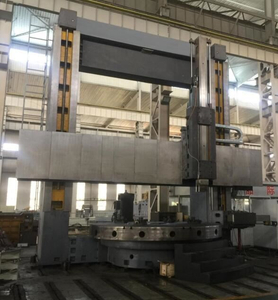
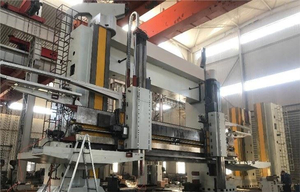
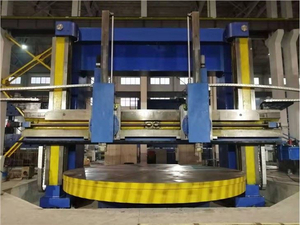
For our CK5 series vertical lathes, the situation is different. Vertical lathes have gravity working in their favor. The workpiece sits on the table, and cutting forces push downward into the table rather than sideways against the guideways. This means vertical lathes can use linear guides more effectively than horizontal lathes of similar size.
Box ways need continuous lubrication. The sliding contact generates heat and wear, so the oil film between the saddle and the way must be maintained at all times. Most modern machines use a forced lubrication system that pumps oil to the ways every few seconds during operation. If this system fails or the oil level drops, you can destroy a set of box ways in under an hour of dry running.
We had a customer in Houston, Texas who ran his CK6180 for three shifts without checking the way lube reservoir. The auto-lube pump ran dry on a Friday night. By Monday morning, the saddle had scored the ways badly enough that we had to send a technician to regrind them. Cost: $3,200 in labor and downtime, plus two days of lost production.
Linear guides have a different maintenance profile. The sealed cartridge design keeps contaminants out and lubricant in. Most linear guides are rated for 10,000 to 20,000 hours of operation before the balls start showing fatigue. You do need to check the seals periodically, especially in environments with heavy coolant mist or fine metallic dust.
A shop in Surabaya, Indonesia runs their CK6163 with linear guides in a mining parts workshop. The environment is full of iron ore dust. After about 18 months, they started seeing increased backlash. When we inspected, we found that the dust had degraded the seals on two of the four linear guide blocks. Replacement was straightforward: $400 for the blocks, plus two hours of labor. But if they had caught the seal damage earlier with a monthly inspection, the blocks would have lasted another year at least.
A linear guide setup typically adds 15% to 25% to the guideway cost of a machine. For a CK6140 size lathe, that means roughly $2,000 to $4,000 more in the initial purchase price. For larger machines like a CK61100, the difference can be $8,000 or more because the linear guides need to be oversized to handle the loads.
But the total cost picture is more complex. Linear guides reduce assembly time in the factory because they are preloaded and pre-adjusted at the guide manufacturer's facility. Box ways require hand-scraping and fitting, which adds 4 to 8 hours of skilled labor per machine. This labor cost is baked into the machine price regardless of which guideway type you choose.
Over a 10-year ownership period, the maintenance costs differ:
Box ways: expect to spend $1,500 to $3,000 on way covers, lubrication system maintenance, and occasional regrinding if abuse occurs. With proper maintenance, box ways last 15 to 20 years or more. We have machines from the early 2000s still running on their original ways in Chile with nothing more than regular oil changes.
Linear guides: expect $800 to $2,000 on seal replacements and block changes over 10 years. Linear guide blocks typically need replacement every 8 to 12 years depending on load and environment. The individual blocks are cheaper to replace than regrinding box ways, but you may need to replace them more frequently.
After building both types for 15 years and shipping to customers across four main markets, here is how we frame the decision:
Choose box ways when: You run heavy roughing cuts, machine large diameter workpieces (over 500mm), deal with interrupted cuts on a regular basis, or work with tough materials like stainless steel, titanium, or high-nickel alloys. Box ways also make more sense if your shop runs lights-out and you cannot afford to check the machine every hour.
Choose linear guides when: You primarily run finishing cuts, work with smaller parts (under 300mm diameter), need fast cycle times for high-volume production, or hold tight tolerances under 0.01mm on finished dimensions. Linear guides also work better if you move the machine frequently, since they are less sensitive to foundation leveling issues.
We had a customer in Santiago, Chile who was buying his first CNC lathe. He was machining aluminum brackets for solar panel mounting frames. Parts were 150mm to 250mm, tolerances around 0.02mm, and he needed to run 200 parts per day. We recommended a CK6150 with linear guides. The fast traverse between operations saved him about 8 seconds per part. Over 200 parts per day, that is 26 minutes of extra production time. Over a year, more than 100 hours. He was producing 12% more parts per shift compared to what a box-way machine would have delivered.
On the other end, a mining equipment repair shop in Medan, Indonesia needed to rebuild hydraulic cylinder rods and gear blanks from 304 stainless and hardened steel. Cuts were deep (4-6mm per pass), parts were 400mm to 600mm diameter, and the material was tough. We recommended a CK6180 with box ways. The rigidity let them take full-depth cuts in a single pass where a linear-guide machine would have needed two or three lighter passes. Total cycle time was actually faster despite the slower traverse speed, because the cutting time per pass was shorter.
Neither guideway type is universally better. The right choice depends entirely on what you are cutting, how big the parts are, and what your tolerance requirements look like. If a salesperson tells you one is always better than the other, they are either selling you something or they have not spent enough time in actual machine shops.
What matters more than the guideway type is how well the machine is built around it. A well-designed box way machine with proper lubrication, good way covers, and quality castings will outperform a cheap linear guide machine every time. And a precision linear guide machine with preloaded blocks and thermal compensation will hold tighter tolerances than even the best box way setup.
Most heavy-duty CNC lathe manufacturers use box ways for large-frame machines. Starfish Machine produces box way configurations across the CK6 series (CK6180 to CK61125) and CK5 vertical lathe series. Other manufacturers in China, Japan, and Germany also use box ways for machines above 500mm swing diameter.
Generally yes, for positioning repeatability. Linear guides achieve plus/minus 0.003mm versus plus/minus 0.008mm for box ways. However, overall machine accuracy depends on many factors beyond guideways, including ball screw quality, thermal stability, and structural rigidity of the castings.
With proper lubrication and maintenance, hardened box ways last 15 to 20 years or more. The key factors are maintaining the oil film, keeping contaminants out with good way covers, and avoiding crash damage. We have machines from over 20 years ago still running on original ways.
Technically possible but rarely practical. The saddle, carriage, and base castings are all designed for the specific guideway geometry. Converting would essentially require rebuilding the machine from the base up. It is more cost-effective to purchase a new machine configured with the guideway type you need.