- All
- Product Name
- Product Keyword
- Product Model
- Product Summary
- Product Description
- Multi Field Search
Views: 0 Author: Site Editor Publish Time: 2026-08-16 Origin: Site


I still remember a phone call from a customer in Mexico a few years back. He had just bought a used CK6150 horizontal lathe and was furious that every shaft he turned came out with a faint taper and inconsistent finish. He blamed the machine, the spindle, the Chinese manufacturer — everyone except the thing actually holding the workpiece. When our engineer finally got eyes on it, the chuck was a cheap three-jaw self-centering unit with jaws so worn they had nearly 0.05 mm of lost motion. A $350 jaw change solved the problem completely.
That story sticks with me because buyers routinely spend tens of thousands on the lathe itself and then treat the chuck like an afterthought. The truth is, no matter how good your spindle bearings are or how rigid your bed is, a worn or mismatched chuck will defeat all of it. In our workshop and across the 500+ machines we have commissioned, the chuck is the single most overlooked component when it comes to part accuracy and repeatability.
So let me walk you through what we have learned about selecting the right chuck, maintaining it properly, and avoiding the mistakes that quietly destroy tolerance.
The first decision is not about brand or size — it is about the type of chuck. We see buyers default to a three-jaw hydraulic chuck because that is what comes standard on most CNC horizontal lathes, but that is not always the right choice.
Three-jaw self-centering chucks are the workhorses. They clamp fast, center reasonably well, and handle round or hexagonal bar stock efficiently. The catch is that "self-centering" does not mean "perfectly centered." After a few thousand cycles, the scroll mechanism wears, and repeatability degrades to 0.03-0.08 mm. For general shaft work where ±0.05 mm is acceptable, a three-jaw is fine. For precision bearing fits, you will want something better.
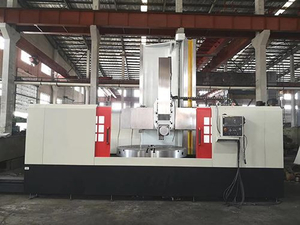
Four-jaw independent chucks let you dial in each jaw separately. They are slower to set up, but they deliver the best concentricity for odd-shaped parts or when you need to correct for casting irregularities. On our CK5 series vertical lathes, four-jaw chucks are common for flange and valve body work where the part may not be perfectly round to begin with.
Collet chucks are the answer when you need speed and precision on small-diameter stock (typically under 65 mm). A collet grips around the entire circumference rather than at three points, which means less distortion on thin-walled parts and better runout — often under 0.01 mm. We had a customer in Brazil making hydraulic fittings who switched from a three-jaw to a collet chuck on his CK6140 and cut his scrap rate from 6% to under 1%.
Face plates and custom fixturing come into play for large, irregular, or asymmetrical parts. This is standard territory on vertical turning centers where the workpiece can weigh several tons and needs bolt-down security rather than jaw clamping.
Here is another mistake we see constantly: buyers spec the largest chuck their lathe can swing, assuming it gives them more capability. What it actually gives them is slower acceleration, more spindle mass, and reduced maximum RPM.
A 315 mm chuck on a CK6150 weighs roughly 55 kg. That mass directly affects how quickly the spindle can reach cutting speed and how smoothly it decelerates. If you are turning parts under 100 mm in diameter 90% of the time, a 250 mm chuck is the smarter choice. The smaller chuck accelerates faster, puts less stress on the spindle bearings, and generally delivers better surface finish at higher RPM.
As a rule of thumb from our application team: the chuck diameter should be 1.5 to 2 times the maximum stock diameter you regularly run. If you run a lot of 80 mm bar, a 200 mm chuck is the sweet spot. Reserve the oversized chucks for jobs that genuinely need them.
Most of the CNC lathes we ship come with hydraulic chucks, and for good reason. A hydraulic chuck clamps with consistent, adjustable pressure in under two seconds. The operator does not need to torque a chuck key, and clamping force stays consistent across every cycle. For production runs above 50 pieces, the time savings alone justify the cost.
But hydraulic is not always the answer. For job shops running one-off or low-volume parts, a manual chuck is simpler, cheaper, and has fewer components to fail. We had a repair shop in Peru that specifically requested manual chucks on two CK6163 machines because they changed setups eight to ten times per day. The hydraulic units would have required constant drawbar adjustment for their wide range of part sizes.
The real issue with hydraulic chucks is maintenance. The drawbar that pulls the chuck wedge mechanism is a wear item. When it starts to go, you will see inconsistent clamping pressure and parts shifting mid-cut. We recommend checking drawbar force every 2,000 hours with a force gauge. If it drops more than 15% from specification, rebuild or replace it before it causes a crash.
If there is one maintenance habit I could force every lathe owner to develop, it is taking care of chuck jaws. I have seen shops run the same set of hard jaws for five years without ever removing them, and then wonder why their parts are out of round.
Jaws wear in specific ways. The gripping surface develops grooves and indentations from repeated clamping, especially on rough bar stock or hot-rolled steel. Those grooves create localized high points instead of full contact, and the part shifts under cutting force. The master jaws that engage the chuck scroll also wear, producing the lost-motion problem I described earlier.
Our standard recommendation:
Every shift: Blow out chips from the jaw ways and chuck body with compressed air. A five-second habit that prevents the most common failure mode.
Every 500 hours: Remove jaws completely, clean the serrations and mounting surfaces, and check for burrs or peening.
Every 2,000 hours: Inspect master jaw engagement. If you can rock the top jaw by hand with any perceptible play, replace the jaws or the master jaws.
Boring soft jaws: When you cut soft jaws to match a specific part diameter, always bore them at the same clamping pressure you will use in production. If you bore at low pressure and then run at high pressure, the jaw deflection changes and your grip diameter shifts.
That last point is something we learned the hard way. A customer in Turkey was boring soft jaws with the hydraulic pressure at minimum to make the operation easier, then running production at full pressure. The jaws deflected differently under load, and every part was coming out 0.04 mm undersize on the OD. Twenty minutes of re-boring at the correct pressure fixed it.
Operators love to crank the hydraulic pressure to maximum. It feels safe — the part cannot possibly fly out. But excessive clamping force is its own source of quality problems.
On thin-walled parts like hydraulic cylinder tubes or bearing races, high clamping pressure physically deforms the workpiece. You machine it perfectly round while it is clamped, but when you release the chuck, the part springs back and your bore goes oval. We saw this repeatedly at a customer in Vietnam machining bronze bushings on a CK6180. They were running at 3.0 MPa clamping pressure and consistently getting 0.05 mm of ovality. Dropping to 1.8 MPa — enough to hold the part securely for the light finishing cuts — brought ovality down under 0.01 mm.
There is no single correct pressure; it depends on the material, wall thickness, cutting forces, and jaw contact area. But here is a starting framework we give customers: for finish cuts on steel parts, 1.5-2.0 MPa is usually sufficient. For roughing on heavy cuts, 2.5-3.0 MPa. For thin-walled or soft materials, start at 1.0 MPa and increase only as needed. Always do a pull test — try to rotate the part by hand with the machine off — before running at full spindle speed.
A dry chuck is a failing chuck. The scroll mechanism, wedge surfaces, and master jaw slides all need regular lubrication to maintain accuracy and prevent seizing. Most chucks require grease every 500 hours of operation, but we have found that in shops with high coolant exposure — especially when using water-based coolant at high pressure — monthly greasing is more realistic.
Use the grease specified by the chuck manufacturer, not whatever is on the shelf. We have seen shops use general-purpose lithium grease on high-speed chucks and then wonder why it flings out at 3,000 RPM. High-speed chucks need a grease rated for centrifugal force and high temperature. The chuck manual will specify it, and it is a $15 tube that lasts a year.
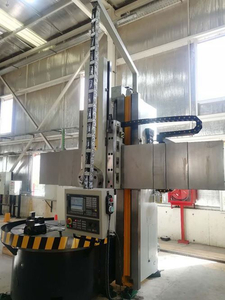
One more thing: if you run a vertical lathe, gravity works against you. Coolant and chips fall straight down into the chuck mechanism. On the CK5 series vertical lathes we build, we recommend a weekly air purge of the chuck body in addition to the normal greasing schedule. It takes two minutes and prevents the seized-chuck teardown that can cost a full day of downtime.
Every chuck reaches a point where maintenance is no longer enough. The question is whether to rebuild it or buy new. Here is how we make that call with customers.
A rebuild kit — new master jaws, scroll or wedge components, and bearings — typically costs 30-40% of a new chuck. If the chuck body itself is in good shape (no cracks, no worn mounting taper, no spindle interface damage), a rebuild makes sense. We have rebuilt Kitagawa and Samchully chucks that went on to run another five years.
But if the chuck body is distorted, the mounting register is worn, or there is any sign of spindle interface damage, replace it. A chuck that does not seat true on the spindle nose cannot be fixed by replacing internal parts. We learned this with a customer in Indonesia who tried rebuilding a 15-inch chuck twice before discovering the mounting taper had worn 0.04 mm out of round. The new chuck paid for itself in eliminated scrap within three weeks.
Your chuck is not an accessory. It is the interface between your machine's precision and your part, and that interface deserves the same attention you give to tooling, feeds and speeds, and coolant. Choose the right type and size for the work you actually do, maintain the jaws and lubrication on a real schedule, and resist the urge to over-clamp. Do those things, and the chuck will quietly deliver accurate parts for years. Ignore them, and even the best lathe in the world will not save you from scrap.
If you are configuring a new machine and are not sure which chuck setup matches your parts, talk to us before you order. We have probably run a setup like yours on one of our horizontal lathes or vertical turning centers, and we would rather get it right before the machine ships than troubleshoot it on your floor.