- All
- Product Name
- Product Keyword
- Product Model
- Product Summary
- Product Description
- Multi Field Search
Views: 0 Author: Site Editor Publish Time: 2026-07-04 Origin: Site


When purchasing a CNC vertical lathe, one of the most important decisions you will face is choosing between a double column and a single column configuration. This choice affects everything from machining accuracy and cutting force capacity to long-term maintenance costs and total purchase price.
As a procurement manager or workshop owner, understanding the technical and commercial differences between these two configurations can save you tens of thousands of dollars in misapplied equipment. This guide provides a detailed, side-by-side comparison so you can make an informed buying decision.
If you need a quotation or want to discuss your specific requirements with a manufacturer, request a free quote here.
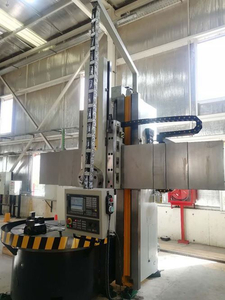
A single column CNC vertical lathe (also called a single-column VBM or vertical turning center) features one vertical column that supports the cross rail and the ram or turret. The workpiece rotates on a horizontal table mounted at the base, while the cutting tool moves vertically and horizontally along the single column.
One vertical column mounted on one side of the base
C-type frame structure — open on three sides
Typically equipped with a single ram or single turret
Cross rail moves up and down the column (Y-axis)
Ram or turret moves left and right on the cross rail (X-axis)
Single column vertical lathes are popular in small to medium workshops. Typical models include:
CK5112 (1,250 mm table diameter)
CK5116 (1,600 mm table diameter)
CK5117 (1,700 mm table diameter)
These machines are well-suited for general-purpose turning of discs, flanges, bushings, and ring-shaped parts.
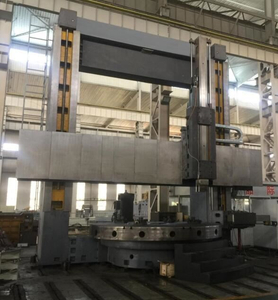
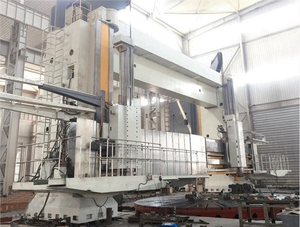
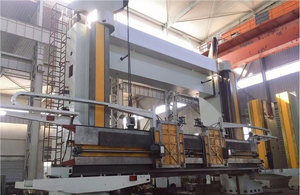
A double column CNC vertical lathe (also called a dual-column vertical boring mill or gantry-type vertical lathe) uses two vertical columns connected by a bridge or cross rail, forming a rigid portal frame. The cross rail moves vertically between the two columns, and the turret or ram traverses horizontally along the cross rail.
Two vertical columns forming a gantry or portal structure
Box-type or bridge-type frame — fully enclosed structure on three sides
Typically equipped with one or two turrets/rams
Higher structural rigidity due to the symmetric frame design
Better resistance to cutting forces and thermal deformation
Double column vertical lathes are used in heavy industry, energy, and aerospace applications:
CK5123 (2,300 mm table diameter)
CK5125 (2,500 mm table diameter)
CK5132 (3,200 mm table diameter)
CK5140 (4,000 mm table diameter)
CK5150 (5,000 mm+ table diameter)
Some manufacturers offer custom double column configurations with table diameters exceeding 8 meters for wind energy and marine applications.
The following table summarizes the most critical differences between double column and single column CNC vertical lathes across key parameters:
Parameter | Single Column | Double Column |
|---|---|---|
Structure | C-frame, open design | Gantry/portal frame, closed design |
Rigidity | Moderate — susceptible to deflection under heavy cuts | High — symmetric frame resists cutting forces |
Max Turning Diameter | 800 mm – 1,700 mm | 2,000 mm – 8,000+ mm |
Max Workpiece Weight | 2 – 10 tons | 10 – 100+ tons |
Turret Configuration | Usually single turret | Single or dual turret |
Machining Accuracy | IT7 – IT8 typical | IT6 – IT7 typical |
Surface Finish | Ra 1.6 – 3.2 µm | Ra 0.8 – 1.6 µm |
Spindle Power | 15 – 37 kW | 37 – 120+ kW |
Price Range (FOB China) | $30,000 – $120,000 | $100,000 – $800,000+ |
Floor Space | Compact (3m × 3m typical) | Large (6m × 6m+ typical) |
Typical Applications | General machining, flanges, bushings | Heavy industry, wind energy, mining, shipbuilding |
Lead Time | 30 – 60 days | 60 – 120 days |
Structural rigidity is the single most important factor that separates double column from single column vertical lathes.
In a single column design, all cutting forces are transmitted through one column. When performing heavy interrupted cuts or machining hard materials like cast iron or stainless steel, the column can experience slight bending or torsional deflection. This deflection directly affects:
Dimensional accuracy — especially on tall workpieces
Surface finish quality — visible chatter marks on the machined surface
Tool life — inconsistent chip load leads to premature wear
Most single column manufacturers compensate for this by limiting recommended depth of cut and feed rates, which reduces material removal rates.
The double column design distributes cutting forces evenly across two columns and the connecting cross rail. This creates a closed force loop that dramatically reduces deflection:
Cutting forces are balanced between the two columns
The cross rail acts as a rigid beam connecting the columns
Thermal expansion is more uniform, reducing thermal drift
Vibration damping is significantly better
For operations requiring tight tolerances (under 0.02 mm) or high material removal rates, the double column structure provides a clear advantage.
When evaluating which vertical lathe to buy, accuracy specifications should be compared carefully.
Accuracy Parameter | Single Column | Double Column |
|---|---|---|
Roundness | 0.010 – 0.025 mm | 0.005 – 0.012 mm |
Cylindricity | 0.015 – 0.030 mm | 0.008 – 0.015 mm |
Flatness | 0.020 – 0.040 mm | 0.010 – 0.020 mm |
Surface Roughness (Ra) | 1.6 – 3.2 µm | 0.8 – 1.6 µm |
Positioning Accuracy | ±0.020 mm | ±0.010 mm |
These values are representative and vary by manufacturer, model, and condition. However, the trend is consistent: double column machines deliver tighter accuracy and finer surface finishes, particularly on large-diameter workpieces.
Single column is sufficient for general-purpose turning where tolerances are ±0.025 mm or looser — for example, flanges, flange adaptors, and structural ring parts
Double column is necessary for precision applications such as aerospace bearing races, wind turbine main shafts, mining gear blanks, and hydraulic valve bodies where tolerances must be held under ±0.010 mm
The most obvious physical difference between the two configurations is their capacity to handle large and heavy workpieces.
Maximum turning diameter: typically 800 mm to 1,700 mm
Maximum workpiece weight: 2 to 10 tons
Suitable for: automotive components, pump and valve parts, small-to-medium flanges, bushings, and discs
Maximum turning diameter: 2,000 mm to 8,000+ mm
Maximum workpiece weight: 10 to 100+ tons
Suitable for: wind turbine hubs and main frames, mining gear rings, ship propulsion shafts, large hydraulic cylinders, pressure vessel heads
If your typical workpiece exceeds 1,700 mm in diameter or weighs more than 10 tons, a single column machine is simply not capable of handling it. In this case, the double column configuration is not a preference — it is a requirement.
Price is always a critical factor in purchasing decisions. Here is a realistic breakdown of what buyers can expect when sourcing CNC vertical lathes from Chinese manufacturers:
Model | Table Diameter | Approximate FOB Price (USD) |
|---|---|---|
CK5112 | 1,250 mm | $30,000 – $55,000 |
CK5116 | 1,600 mm | $50,000 – $85,000 |
CK5117 | 1,700 mm | $60,000 – $120,000 |
Model | Table Diameter | Approximate FOB Price (USD) |
|---|---|---|
CK5123 | 2,300 mm | $100,000 – $180,000 |
CK5125 | 2,500 mm | $150,000 – $250,000 |
CK5132 | 3,200 mm | $250,000 – $400,000 |
CK5140 | 4,000 mm | $350,000 – $550,000 |
CK5150+ | 5,000+ mm | $500,000 – $800,000+ |
Several variables affect the final price regardless of column configuration:
Control system — Fanuc and Siemens add $10,000 – $30,000 over Chinese domestic controls (GSK, KND, Huazhong)
Turret type — Hydraulic turret vs. power turret vs. manual tool post
Spindle bearing quality — P4-grade vs. P5-grade bearings
Tool changer — Automatic tool changer (ATC) capability
Coolant and chip conveyor — Through-spindle coolant, high-pressure coolant system
Shipping and installation — Double column machines require flat rack containers and specialized rigging
When requesting a quotation from a manufacturer or supplier, always specify the configuration options you need. The base price can be misleading.
The total cost of ownership extends well beyond the purchase price. Maintenance requirements differ significantly between single column and double column vertical lathes.
Simpler structure — fewer components, easier to access for maintenance
Lower lubrication requirements — one column way, one cross rail
Guideway replacement — less expensive, but may be needed more frequently under heavy use
Alignment checks — must be performed regularly to detect column deflection
Estimated annual maintenance cost — $2,000 – $8,000 depending on usage intensity
More complex structure — two columns, cross rail, additional guideways
Higher lubrication consumption — more way surfaces require oil or grease
Guideway scraping or replacement — more expensive but less frequently needed due to lower wear rates
Cross rail levelness adjustment — periodic alignment required between the two columns
Estimated annual maintenance cost — $5,000 – $20,000
While double column machines cost more to maintain, their higher rigidity means less unplanned downtime, fewer scrapped parts due to accuracy drift, and longer intervals between major overhauls. For high-volume production environments, the lower per-part cost often offsets the higher maintenance expense.
Choosing between double column and single column depends heavily on your specific application. Here are recommendations by industry:
Automotive parts manufacturing — brake discs, wheel hubs, differential housings
Pump and valve industry — flanges, impellers, valve bodies under 1,500 mm
General machining workshops — job shops handling diverse small-to-medium parts
Agricultural machinery — gears, sprockets, bushings
Electrical energy (distribution) — transformer base plates, switchgear components
Wind energy — turbine hubs, main frames, yaw bearings, pitch bearings
Mining equipment — large gear rings, crusher components, excavator slew rings
Shipbuilding — propeller shafts, stern tube components, rudder stock
Oil and gas — wellhead flanges, BOP housings, large valve bodies
Heavy machinery — press frames, roll necks, hydraulic cylinder heads
Railway — wheelset axles, bogie frames, traction motor housings
If you are still unsure which configuration to purchase, consider these five decision factors:
Measure your largest typical workpiece in diameter, height, and weight. If it falls within single column capacity, you have the option of either. If it exceeds single column limits, the decision is made for you.
Review your drawing specifications. If you need to hold tolerances tighter than ±0.015 mm on diameter or achieve surface finishes better than Ra 1.6 µm, a double column machine will give you more consistent results.
High-volume production (more than 50 parts per month of the same type) benefits from the higher rigidity and lower cycle time variability of double column machines. Low-volume or prototype work may be more cost-effective on a single column machine.
If your capital expenditure is limited, a single column machine provides a lower entry point. However, factor in the cost of potential outsourcing for large-diameter work that the single column cannot handle.
Consider your order pipeline and industry trends. If you are entering markets like wind energy or mining that trend toward larger components, investing in a double column machine now may avoid a costly upgrade in 2–3 years.
China is the world's largest producer of CNC vertical lathes, with dozens of manufacturers offering both single and double column configurations. When sourcing from China, keep these points in mind:
Verify the manufacturer — ask for factory audit reports, ISO 9001 certification, and references from buyers in your region
Request test cuts — reputable manufacturers will perform a test cut on your sample part or a representative workpiece before shipment
Specify the control system — confirm whether the quotation includes Fanuc, Siemens, or a domestic control, as the price difference is significant
Clarify warranty terms — standard warranty is 12 months from the date of installation, but some manufacturers offer extended warranties
Plan for installation — double column machines require professional installation, foundation work, and calibration. Factor this into your total budget
For a list of verified Chinese CNC vertical lathe manufacturers and a free quotation, contact our team here.
Decision Factor | Single Column | Double Column |
|---|---|---|
Workpiece size up to 1,700 mm | ✅ Ideal | ❌ Oversized |
Workpiece size over 2,000 mm | ❌ Not capable | ✅ Ideal |
Tight tolerance (<±0.015 mm) | ⚠️ Possible with care | ✅ Consistent |
Budget under $100,000 | ✅ Affordable | ❌ Higher cost |
Heavy interrupted cuts | ⚠️ Limited | ✅ Handles well |
Compact workshop space | ✅ Fits easily | ❌ Requires large area |
Future growth potential | ⚠️ Limited by size | ✅ Scalable |
The choice between a double column and single column CNC vertical lathe is ultimately driven by your workpiece requirements, accuracy demands, production volume, and budget. Both configurations have a valid place in modern manufacturing — the key is matching the machine to the application.
Need help selecting the right CNC vertical lathe for your application? Whether you need a compact single column CK5112 or a heavy-duty double column CK5132, our team can provide specifications, pricing, and lead times from verified Chinese manufacturers.