- All
- Product Name
- Product Keyword
- Product Model
- Product Summary
- Product Description
- Multi Field Search
Views: 0 Author: Site Editor Publish Time: 2026-08-21 Origin: Site


I used to think chip management was one of those boring topics that nobody cared about - until a customer in Brazil called me at 2 AM saying his spindle was making a noise "like grinding rocks." He was machining gray cast iron on a CNC horizontal lathe, and fine iron dust had been quietly infiltrating the spindle bearings for months. When we finally pulled the spindle, the bearings were completely destroyed. Replacement cost: $6,200 plus three weeks of downtime.
That one incident changed how I look at chip management. In our 15 years of exporting CNC lathes, we have found that chip-related problems are responsible for roughly 15 to 20 percent of unplanned downtime on customer machines. That is not a small number. Chips are not just a housekeeping issue. They are a reliability issue, a quality issue, and ultimately a profitability issue.
Over the years, I have walked through dozens of shops where chip management was an afterthought. The machines looked fine from the outside. But underneath those way covers, around the tool turret, and inside the chip conveyor, problems were building up silently. In this article, I will walk you through the six most common chip problems we have fixed on customer machines, along with what actually works to prevent them.
This is the most visible chip problem and probably the one machinists hate the most. When you are turning ductile materials - low carbon steels, austenitic stainless steels, some aluminum alloys - the chips do not break neatly. They come off in long, stringy ribbons that wrap around the workpiece, the tool holder, sometimes even the chuck jaws.
We had a customer in Vietnam machining 304 stainless steel shafts on a CK6 series horizontal lathe. The operator kept running the same parameters he used for carbon steel, and the result was a bird's nest of chips wrapped around every part. The chips were re-cutting into the finished surface and ruining the surface finish. Worse, one shift the chips wrapped so tightly around a part that they actually pulled it slightly out of the chuck jaw. The part flew at 1,200 RPM. Nobody was hurt, but they scrapped a $400 forging and bent a tool holder.
The fix here is almost always about insert geometry and cutting parameters, not about the machine. Use chip breaker inserts designed for your specific material. Most insert catalogs have a medium or general purpose geometry for stainless steels that produces smaller C-shaped chips. Increase your feed rate. Running too slow with too light a feed is the number one cause of stringy chips in stainless. We typically recommend 0.2 to 0.3 mm per revolution for semi-finishing 304 SS, compared to the 0.1 mm per rev this customer was using.
Through-tool coolant also helps significantly. A high-pressure coolant stream directed at the cutting zone breaks the chip short and flushes it away before it can wrap. If your machine does not have through-tool coolant, angling the external nozzle closer to the cutting edge is a decent workaround.
The chip conveyor is one of those components that gets ignored until it stops working. Then suddenly you have got chips piling up in the machine bed, production is halted, and you are looking at an expensive repair.
We have seen three main failure modes across hundreds of installations. The first is hinge belt stretch. On standard hinge belt conveyors running steel chips, the belt stretches over time. If you do not adjust the tension, the belt starts slipping on the drive sprocket, then eventually jumps the sprocket entirely. One customer in Turkey ran a CK6163 for two years without checking conveyor tension. When the belt finally jumped, it twisted and tore, taking out the conveyor motor. Total repair bill was around $1,400.
The second failure mode is abrasive wear. If you are machining titanium, Inconel, or even hardened steels, the chips are extremely abrasive. They eat through standard hinge belt links in a fraction of their normal life. The same Turkish customer later switched to titanium aerospace parts and went through two hinge belts in eight months before we recommended upgrading to a scraper chain conveyor.
The third failure mode is motor burnout from overload. This happens when chips jam in the conveyor, usually because foreign objects like broken tool bits, workpiece chunks, or bolts fall into the conveyor trough. The motor tries to push through the jam, draws excessive current, and burns out.
What actually works: check conveyor belt tension monthly. For abrasive materials, spec a scraper chain conveyor when ordering the machine. It costs maybe 20 to 30 percent more but lasts 3 to 4 times longer in abrasive applications. And install a simple mesh screen at the conveyor inlet to catch large debris before it enters the trough.
Way covers - those telescoping steel shields that protect the linear guideways - are a critical but often overlooked component. When they are working properly, you do not think about them. When chips get past them, the damage can be severe and expensive.
Here is what typically happens. Chips accumulate on top of or beside the way covers. Over time, the weight and vibration cause chips to work their way past the wiper seals. Once fine chips get between the cover panels and the actual slideway surface, they act like lapping compound. Every time the axis moves, those embedded particles score the cast iron or steel slideway.
We saw this with an Indonesian customer running a CK6180 horizontal lathe for high-volume aluminum machining. Aluminum chips are deceptively problematic. They are soft but sticky, and they pack tightly into every gap. The operator had been running the machine for 14 months without pulling the way covers for cleaning. When we finally inspected it during a service visit, the X-axis slideway had deep scores - 0.3 mm deep in several places. The repair involved re-scraping the slideway by hand and replacing two telescopic cover sections. Total cost: $3,200 plus four days of downtime.
The prevention is simple but requires discipline. Blow out the way cover area with compressed air at the end of every shift. If you see any damage to the way cover wiper strips - those rubber or brush seals at the edges - replace them immediately. They cost $20 to $50 each and take 10 minutes to swap. That $30 seal is protecting a slideway worth thousands.
This is the problem I mentioned at the start, and honestly it is the one that keeps me up at night. Fine chips - particularly from cast iron, brass, and certain powdered metal parts - are small enough to migrate past spindle seals and into the bearing housing. Once inside, they circulate with the grease or oil, grinding away at the bearing races and rolling elements.
A typical CNC lathe spindle uses precision angular contact bearings rated for 15,000 to 20,000 hours of operation. When contamination gets in, that life can drop to 3,000 to 5,000 hours or worse. And you will not notice until the spindle starts making noise or you see a deterioration in surface finish on your parts.
The Brazilian cast iron customer I mentioned? His machine ran for about 4,000 hours before the spindle started vibrating badly. We pulled the bearings and found fine iron dust had completely contaminated the grease. The bearing races were covered in tiny pits - what bearing engineers call "dirty lubrication wear." The spindle was essentially destroyed.
To prevent this, we now recommend quarterly checks of the spindle seal integrity on any machine running cast iron or brass. Check for visible gaps or wear around the labyrinth seals. Some of our customers have added positive air purge systems - a low-pressure air line that blows a thin curtain of clean air at the seal interface, keeping fine dust out. It is a $200 modification that can save you a $6,000 spindle rebuild.
We also suggest monitoring spindle vibration monthly with a simple handheld vibration meter. A healthy spindle runs below 2.5 mm/s velocity. Once you see it creeping above 4.5 mm/s, start planning bearing inspection. Catch it early enough, and you might save the spindle shaft. Catch it late, and you are buying a whole new spindle assembly.
Modern CNC lathes use either hydraulic tool posts or servo-driven turrets with 8, 10, or 12 stations. These are precision mechanisms with tight tolerances - typically 0.005 to 0.01 mm repeatability. They do not take kindly to chip contamination.
Chips tend to accumulate around the turret base, especially on machines where the turret sits low and the chip flow is directed toward it. Over time, the chip pile grows. Eventually, chips work their way into the turret indexing mechanism. The result: the turret does not fully rotate to position, or it indexes slightly off-center.
A customer in Mexico was running aluminum brake caliper blanks on a CK6140. The shop ran two shifts, five days a week, and the chip conveyor was located behind the spindle - meaning chips from the front tool positions fell directly into the turret area. After about six months, the BMT turret started occasionally failing to lock at certain positions. The operator would hit cycle start, the turret would try to index, and the alarm would trip: "Turret lock error."
We traced it to aluminum chips packed into the curvic coupling - the toothed coupling that locks the turret in position. The chips prevented full engagement, so the turret was not rigid enough for cutting and would shift under load. We cleaned out the coupling, replaced the turret base seals, and added an air blast nozzle aimed at the turret base. The problem has not recurred in the 18 months since.
The lesson: include turret area cleanout in your daily maintenance routine. Five minutes of blowing chips away from the turret base at shift end costs nothing compared to a curvic coupling rebuild.
This is a purchasing mistake, and it is surprisingly common. Most CNC lathe buyers focus on spindle specs, swing capacity, and control system. The chip conveyor gets whatever standard configuration comes with the machine. But the standard conveyor is usually designed for mild steel chips - and that is not what everyone machines.
Here is a quick breakdown of what we have learned from configuring hundreds of machines:
Hinge belt conveyors work well for steel and stainless steel chips. The chips sit on top of the metal slats and get carried up to the discharge point. But they are terrible for fine, powdery chips from cast iron - the particles fall through the gaps between the slats and pile up underneath. They are also poor for long, stringy aluminum chips that wrap around the sprockets.
Scraper chain conveyors drag a chain with scraper blades along the bottom of the trough. They handle cast iron dust, brass chips, and abrasive materials much better because there are no gaps for fine particles to fall through. The trade-off is higher noise and slightly more power consumption.
Auger conveyors use a rotating helical screw to move chips. They are good for wet chips (when using heavy coolant flow) and for chip removal from deep pits. But they struggle with long stringy chips that wrap around the screw.
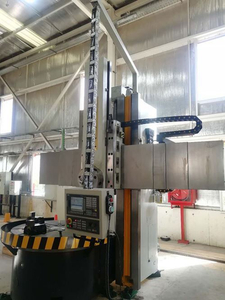
We had a customer in Thailand who ordered a CK5 series vertical lathe for machining high-manganese steel wear parts. Manganese steel is notorious for work-hardening, and the chips are incredibly tough and stringy. The standard hinge belt conveyor could not handle them - chips wrapped around the drive shaft and jammed the conveyor solid three times in the first week. We ended up shipping a heavy-duty scraper chain conveyor as a retrofit, which cost about $2,800 including installation. If they had specified the right conveyor at the time of purchase, it would have been included in the base price.
Our advice: when you request a quotation for a new CNC lathe, always tell the supplier what materials you will be machining and what your chip shape looks like. A five-minute conversation at the ordering stage can save you thousands in retrofit costs and downtime later.