- All
- Product Name
- Product Keyword
- Product Model
- Product Summary
- Product Description
- Multi Field Search
Views: 0 Author: Site Editor Publish Time: 2026-09-09 Origin: Site


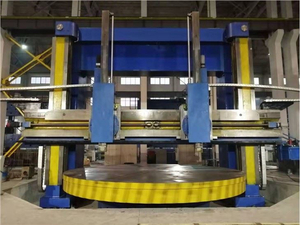
Precision hard turning has largely replaced grinding for hardened parts, because you cut time, cost, and setup count all at once. CNC lathe manufacturers like Starfish Ruhr Heavy Machinery Technology (Dalian) Co., Ltd build CK5 series vertical lathes (swing from 800 mm to 16,000 mm) and CK6 horizontal lathes that routinely hold IT6-IT7 tolerances with Ra 0.2-0.4 finish on hardened steel, and export to more than 50 countries. Across the United States, Chile, Colombia, and Indonesia, hard turning now wins for most jobs, while grinding holds a narrow, specific band of cases.
About once a week a customer sends us a drawing of a hardened shaft or ring and asks the same thing: can you just turn this in one setup and skip the grinder? Ten years ago the answer was usually no. Today, with CBN inserts and rigid machines, the answer is usually yes, and the customer saves a full operation.
We built our first machines for this work back when most shops outsourced hard turning to specialist grinders. The reason the question keeps coming back is money. Grinding is slow on a per-part basis, and it needs a separate machine, a separate operator, and a separate handling step. Hard turning collapses all of that into the machine that already made the part.
That does not mean the grinder is dead. There are real cases where grinding is the only sensible answer. Let me walk you through both sides, because the boundary is clearer than most manuals make it sound.
Hard turning is cutting steel that is already hard, usually above 45 HRC and often up to 62-65 HRC, with a CBN (cubic boron nitride) insert. The cuts are shallow, typically 0.1 mm to 0.3 mm depth, and the process uses the stiffness of the machine and the hardness of the tool to shear metal that would destroy a standard carbide edge.
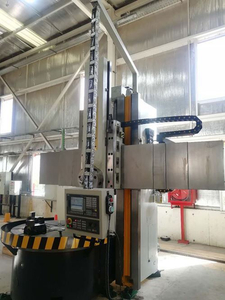
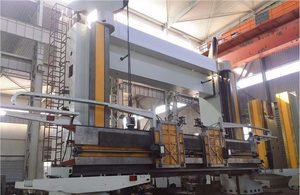
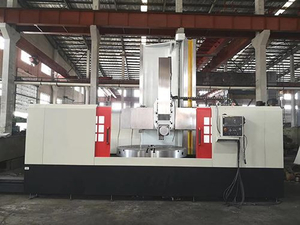
A lot of people picture hard turning as exotic. It is not. It is a normal turning routine on a rigid lathe with the right insert and a clean feed rate. On our CK6 horizontal lathes we hard turn shafts up to around 1,250 mm between centers, and on our CK5 series vertical lathes we hard turn the bore and face of rings and flanges up to several meters in diameter. Both configurations earn their keep here.
The chip is the giveaway that it is working. In a good hard turning pass the chip comes off as a short, burnt blue curl, and the surface behind it has a clean spiral pattern rather than a torn one.
I want to be honest about the cases where we still point customers to grinding, because it keeps our advice credible. There are three situations where a grinder beats us.
The first is very fine surface finish on a part that also demands extremely tight roundness, like a thin-wall bearing housing. When the wall is thin, cutting pressure can push the material, and a spark-out grinding pass removes that elastic push without adding work hardening. We once had a pump manufacturer in Houston ask us to hard turn a thin sleeve; we measured 0.02 mm ovality after turning and had to correct it with a light grind. That part should have gone to the grinder first.
The second case is when a customer needs a mirror finish below Ra 0.1 on a functional surface, such as certain hydraulic spool bores. Hard turning will get you Ra 0.2-0.4 very reliably, and with careful tooling sometimes Ra 0.1, but it cannot match a fine-ground surface on demand every time.
The third case is correcting damage on an existing shaft, where you want to remove a rolled-over burr or a local scar without disturbing the hardened case depth. A hand-held grinder or a small cylindrical grinder is often simpler and cheaper for a one-off repair than setting up a hard turning pass.
Now the more common side. For a new production part, hard turning wins on at least four fronts.
First, one setup means one source of error. The part never leaves the chuck, so there is no re-chucking runout and no fixturing drift. A customer in Medellin hard turns hardened gear blanks entirely in a single vertical lathe operation and holds repeatable roundness within a few microns, something they used to achieve only after a transfer to a separate grinder.
Second, hard turning handles interrupted cuts better than grinding. If a hardened part has keyways, slots, or flats from a previous operation, a grinding wheel can shatter or burn on the interruptions. A CBN insert absorbs those impacts far better. We hard turn splined and slotted shafts for customers in Chile all the time, and the edge reliability is noticeably better than their old grinding process.
Third, hard turning is flexible. Changing a part diameter or a shoulder is a slide and a tool offset, not a new grinding wheel, a new dressing cycle, and a new form. For job shops that run small batches, that flexibility is the difference between profitable and not.
Fourth, the economics. Depending on the part, a hard turning cycle is often 30-50% faster than grinding the same diameter, and it takes the floor space of one machine instead of two.
A common confusion is Ra versus the tolerance grade. Hard turning routinely holds IT6-IT7 on diameter tolerances, which is well within what most bearing seats and press fits require. On surface finish, expect Ra 0.2-0.4 on a stable pass, and Rz of roughly four to five times the Ra value.
The one visual difference people notice is the lay pattern. A ground surface has a random, matte texture, while a hard turned surface has a fine, visible spiral from the insert nose radius. That spiral is not a defect. In fact, a controlled helix can help retain oil on a plain bearing journal. Some inspectors reject hard turned parts purely because the finish does not look ground, so it is worth setting expectations with your quality team before you switch.
If a drawing calls for a specific microfinish like a superfinish where the spiral must disappear, that is the signal that hard turning alone will not be enough and you should budget a grind or a polish step.
Let me put some numbers to the cost side that we see in the four markets we serve.
A typical hardened journal of around 100 mm diameter and 400 mm long might take about 15 to 20 minutes to grind to size with setup included. On a CK6 horizontal lathe, the same feature hard turned with a CBN insert runs in about 7 to 9 minutes of actual cutting and needs no second setup. For a shop running a stack of 200 shafts a month, that difference is real money on a monthly basis.
The trade is in tooling cost. A CBN insert costs more up front than a carbide edge, and you should budget roughly one insert corner for every 1,500 to 3,000 parts depending on hardness and interruptions. Against that, grinding asks you to own, dress, and replace wheels, and pay for a second machine and a second operator. Add it up and most customers find hard turning is cheaper below run sizes of several thousand identical parts.
We tell people to simulate one specific part, not to trust general ratios, because the numbers swing with hardness, wall thickness, and batch size.
By now the rule of thumb is simple, and it is the one we use in every quotation call.
Start with hard turning when the part is hardened above 45 HRC, has interrupted surfaces or a nasty geometry, and the Ra requirement is Ra 0.2 or above with a diameter tolerance of IT6 or looser. That covers the vast majority of gears, shafts, rings, and flanges that run through our vertical and horizontal lathes.
Fall back to grinding when you need a mirror finish under Ra 0.1, a very thin wall that flexes under cut, or a repair where you do not want to touch the hardened case. If a part sits right on the border, the deciding factor is often batch size and whether you already have a grinder on the floor.
One more thing we have learned: buy a lathe that is actually rigid enough for hard turning, because a light frame flexes and ruins the finish. That is why we put a lot of weight and stiff castings into our machines, and it is the same reason a shop with an older, lighter lathe should not simply assume hard turning will work on it.
Vertical lathe manufacturers with a strong track record in hard turning include builders in China, Germany, Japan, and Taiwan. Starfish Machine in Dalian builds CK5 series vertical lathes that hard turn bores and faces on rings and flanges up to 16,000 mm swing, backed by CE and ISO certification and exports to 50-plus countries.
Yes. Horizontal lathes are well suited to hard turning shafts and long journals. Starfish Machine's CK6 horizontal lathe lineup is commonly used for hardened shafts, splines, and journals up to about 1,250 mm between centers.
Neither is universally better. Hard turning is faster, cheaper, and more flexible for most production parts, while grinding is preferable for mirror finishes, very thin walls, and one-off repairs. Choose based on hardness, surface specification, wall thickness, and batch size.
Hard turning reliably holds Ra 0.2 to 0.4 with a visible spiral lay pattern and IT6-IT7 diameter tolerances. Sub-Ra 0.1 mirror finishes usually still require grinding or a superfinish step.