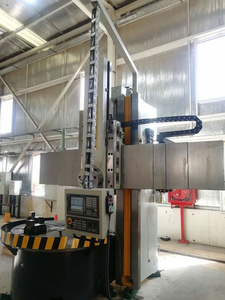
CNC Horizontal Lathe: Suitable & Unsuitable Scenarios (Email Version)
I. Suitable for CNC Horizontal Lathes
1. Revolving body parts
Typical parts include shafts (transmission shafts, rollers, lead screws), sleeves (sleeves, bearing blocks), flanges, discs, pipe fittings and connectors. These parts, mainly featuring outer circles, inner holes, end faces, threads and grooves, are ideal for turning.
2. High precision requirements
It ensures excellent dimensional consistency, roundness, coaxiality and stable surface roughness. Controlled by programs, CNC enables stable repeated machining, far better than conventional lathes.
3. Batch production or repeat orders
For regular production of the same or similar parts, the program can be set once and reused repeatedly. This greatly reduces setup time, labor dependence and quality fluctuations. The larger the batch and the higher the repetition, the more cost-effective it is.
4. Slightly complex part structures
Applicable for parts with threads (metric/British/tapered), step shafts, internal/external grooves, chamfers, fillets or simple compound curved surfaces. Unlike manual lathes (low efficiency, high error rate), CNC lathes finish machining in one operation, with stability and safety guaranteed.
5. Reduced reliance on skilled technicians
Conventional lathes require senior operators, while CNC lathes only need personnel with programming and setup skills. It’s a clear trend amid labor shortages and rising labor costs.
6. Hard materials or high cutting intensity
Suitable for alloy steel, stainless steel, cast steel, high-strength shaft materials, etc. CNC lathes boast better rigidity, controllable cutting parameters and more stable tool life.
II. Not Necessary for CNC Horizontal Lathes
1. Single-piece production, minor repairs or extremely simple structures
Such as one-off simple shafts, old part repairs or parts requiring frequent dimension adjustments. Conventional lathes are more economical and allow quicker adjustments.
2. Parts dominated by flat surfaces
For parts needing only step milling, groove milling or hole matrix processing, machining centers or milling machines are more suitable.