
- All
- Product Name
- Product Keyword
- Product Model
- Product Summary
- Product Description
- Multi Field Search
Views: 0 Author: Site Editor Publish Time: 2025-07-22 Origin: Site


Drilling machines are essential in a wide variety of industries, from manufacturing and automotive to aerospace and construction. These machines are used primarily for creating round holes in materials such as metal, wood, plastic, and even concrete. Whether it's for precision tasks or large-scale production, drilling machines play a pivotal role in modern manufacturing. In this article, we will explore what drilling machines are used for, the different types of drilling machines, their applications in various industries, and how to choose the right machine for your needs.
A drilling machine is a tool used to create round holes in solid materials by rotating a drill bit against the workpiece. The machine rotates the drill bit at high speeds while applying pressure to the material, effectively cutting through it and creating a hole. Drilling machines are used in a variety of tasks, ranging from simple hole-making to more complex applications such as tapping, counterboring, and reaming.
The main purpose of a drilling machine is to make holes. However, with specific attachments and accessories, drilling machines can perform a wide variety of tasks. These include:
Drilling holes: Creating round holes of various sizes.
Tapping: Creating internal threads inside holes for screws or bolts.
Counterboring: Enlarging a hole to fit a larger fastener or bolt head.
Reaming: Enlarging and smoothing a hole to a precise diameter.
Bench Drills: Ideal for small, light-duty tasks and limited workpieces.
Pillar Drills: More versatile than bench drills, capable of handling medium-sized workpieces and providing better precision.
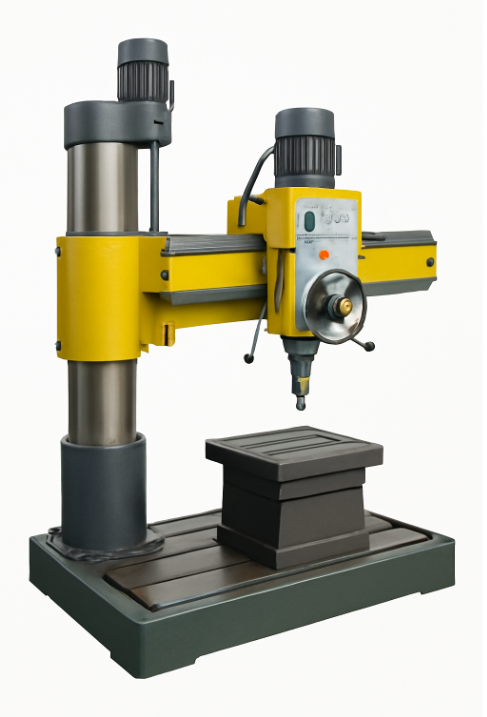
Radial Drilling Machines: Advanced machines that allow the spindle to move in multiple directions, providing flexibility for large or heavy workpieces.
CNC Drilling Machines: Computer-controlled machines used for precision and high-volume drilling, often in automated production environments.
Drilling for Component Assembly: In the manufacturing industry, drilling machines are used to create holes in parts that will be assembled into larger products. For example, in automotive manufacturing, drilling machines are essential for making holes in engine blocks, chassis, and other components that are then assembled to create a vehicle.
Mass Production: CNC drilling machines are commonly used in high-volume manufacturing because they provide precision and automation, reducing the need for manual labor. These machines can drill thousands of parts with consistent accuracy, making them ideal for large-scale production.
Drilling Engine Blocks and Transmission Components: In the automotive industry, drilling machines are used extensively to create holes in engine blocks, transmission parts, and other components that require precise alignment for fitting bolts and fasteners.
Precision Drilling for Parts Assembly: Automotive manufacturing relies on drilling machines to ensure that components such as gears, suspension parts, and internal engine components fit together seamlessly. Precision drilling is critical for the functionality and safety of vehicles.
Drilling for Structural Components: In the aerospace industry, drilling machines are used to create holes in structural components of airplanes and spacecraft. These parts must meet extremely high standards for weight reduction and durability, making precision drilling essential.
Component Fabrication: Drilling machines play a key role in fabricating hundreds of parts used in aircraft, from wing spars to turbine components, ensuring holes are drilled to exact specifications for assembly and function.
Drilling for Fasteners and Anchors: Drilling machines are also used in the construction industry for creating holes for anchors, bolts, and fasteners that hold structural components together. This can include drilling into concrete, metal, or steel beams.
Drilling in Concrete and Metal: Specialized core drills and hammer drills are used to drill through hard materials like concrete and metal, which are common in large-scale construction projects.
Drilling for Exploration and Extraction: In the oil and gas industry, drilling machines are crucial for extracting resources deep within the earth. These machines bore holes several kilometers deep to reach oil and gas reserves.
Creating Holes for Pipes and Tubes: Drilling machines are also used in oil rigs to create holes for pipes, tubes, and valves, which are essential for transporting the extracted materials.
Wood Drilling: Woodworking shops often use drilling machines to create precise holes for screws, dowels, and joinery in furniture, cabinetry, and other wood products. Specialized wood drilling machines are designed with sharp bits to avoid splintering or damaging the wood.
Metal Drilling: Drilling machines in metalworking shops are designed for drilling through various metals, including steel, aluminum, and brass. These machines often feature high-speed rotating bits made from durable materials like carbide to handle the hardness of metals.
Plastic Drilling: For drilling plastics, special machines or attachments may be used to avoid cracking or deformation. Plastic drilling requires the use of slow speeds and specific drill bits to ensure clean and accurate holes.
Tapping Holes: Some drilling machines come with tapping attachments to create threaded holes. Tapping involves cutting internal threads into the hole so that bolts or screws can be inserted.
Threading Operations: Drilling machines used for threading are equipped with attachments that allow for creating internal or external threads in the workpiece.
Counterboring: This process involves drilling a hole to a larger diameter at the top, allowing a fastener (like a bolt) to sit flush with the surface. Drilling machines used for counterboring are equipped with specialized counterbore bits.
Reaming: Reaming is used to enlarge an existing hole to precise dimensions. This is often done after drilling to smooth the hole's surface or achieve a more accurate diameter.
Drilling machines are known for their ability to produce holes with high precision. CNC drilling machines, in particular, provide automated accuracy, which is critical for industries such as aerospace and automotive, where even the smallest deviation can lead to significant problems.
With the right attachments, drilling machines can be adapted for different operations such as tapping, reaming, and counterboring. This versatility makes them indispensable in many industries.
Modern drilling machines, especially CNC models, can perform multiple operations quickly and with minimal downtime. Automated drilling can significantly reduce the time required to produce high volumes of parts, improving production efficiency.
Drilling machines automate many of the repetitive and labor-intensive aspects of hole-making, reducing the need for manual intervention. They are also designed with safety features like shields and automatic stop mechanisms to protect the operator.
Material Type: If you're working with metal, you'll need a machine with a high-speed rotating drill bit, often carbide-tipped, to handle the hardness of metal. For wood or plastic, a less powerful machine may be suitable.
Hole Size and Depth: Depending on the size and depth of the holes you need to drill, you may require a machine with adjustable speed settings or additional attachments for deep-hole drilling.
Production Volume: High-volume tasks benefit from CNC drilling machines that can automate the process and maintain high precision, reducing the need for manual labor.
Precision Requirements: For highly precise tasks, such as drilling for aerospace components, a CNC or pillar drilling machine may be the best option.
Bench Drills: Perfect for small-scale tasks and basic hole drilling, commonly used in workshops and for home projects.
Pillar Drills: Suitable for medium-scale tasks, offering higher precision and the ability to handle larger workpieces.
Radial Drills: Ideal for drilling large or irregularly shaped workpieces that need flexibility in positioning.
CNC Drills: Best for automated tasks with high precision, such as in mass production environments or complex engineering projects.
Lubrication: Regular lubrication of moving parts is essential to maintain smooth operation and prevent wear and tear.
Cleaning: Clean the machine after each use to prevent debris buildup that can affect the machine’s performance.
Inspection: Regular inspections ensure that parts such as the drill bit, spindle, and alignment mechanisms are in proper working order.
Overheating: Overheating can be prevented by regularly checking and maintaining the cooling system, especially in high-speed drilling tasks.
Misalignment: Ensuring the alignment of the spindle and drill bit can prevent inaccurate holes and uneven drilling.
Drill Bit Wear: Monitoring the condition of the drill bit is crucial, as worn-out bits can affect performance and accuracy.
Drilling machines are indispensable tools in the manufacturing and construction industries, offering precision, versatility, and efficiency. Whether you're working in a small workshop or a large industrial facility, choosing the right drilling machine for your needs is essential for optimizing productivity and ensuring high-quality results.
A: The primary function of a drilling machine is to create round holes in materials through a rotating drill bit.
A: Consider factors like material type, hole size, precision requirements, and production volume when selecting a drilling machine.
A: Drilling machines can handle various materials, including metal, wood, plastic, and concrete.
A: CNC drilling machines are computer-controlled and offer automation, precision, and efficiency, whereas manual drills are operated by hand and require more labor.


