
- All
- Product Name
- Product Keyword
- Product Model
- Product Summary
- Product Description
- Multi Field Search
Views: 0 Author: Site Editor Publish Time: 2025-10-09 Origin: Site



A cnc vertical machining center is a powerful machine tool that lets you shape metal or plastic parts with amazing accuracy. You’ll find these machines in many manufacturing settings because they help you create parts quickly and safely. Just look at how important they’ve become—the market reached $9.71 billion in 2024 and should hit $10.23 billion by 2025:
Year | Market Size (USD Billion) |
|---|---|
2024 | 9.71 |
2025 | 10.23 |
2035 | 17.24 |
With a cnc, you spend less hands-on time and get more work done faster. If you’re new to machining, don’t worry—these machines make it easier to get started and boost your skills.
CNC vertical machining centers (VMCs) are useful machines. They can shape metal and plastic parts very accurately. This makes them great for many industries.
VMCs are easy for beginners to use. People can learn them quickly. They help make parts fast and save money.
It is important to know the main parts of a VMC. These include the spindle, table, and control panel. Knowing these helps you use and take care of the machine well.
You must do regular maintenance and safety checks. This keeps VMCs working well. It also helps stop accidents in the workshop.
Picking the right VMC means thinking about your workpiece size. You also need to know what materials you will machine. This helps the machine work its best.
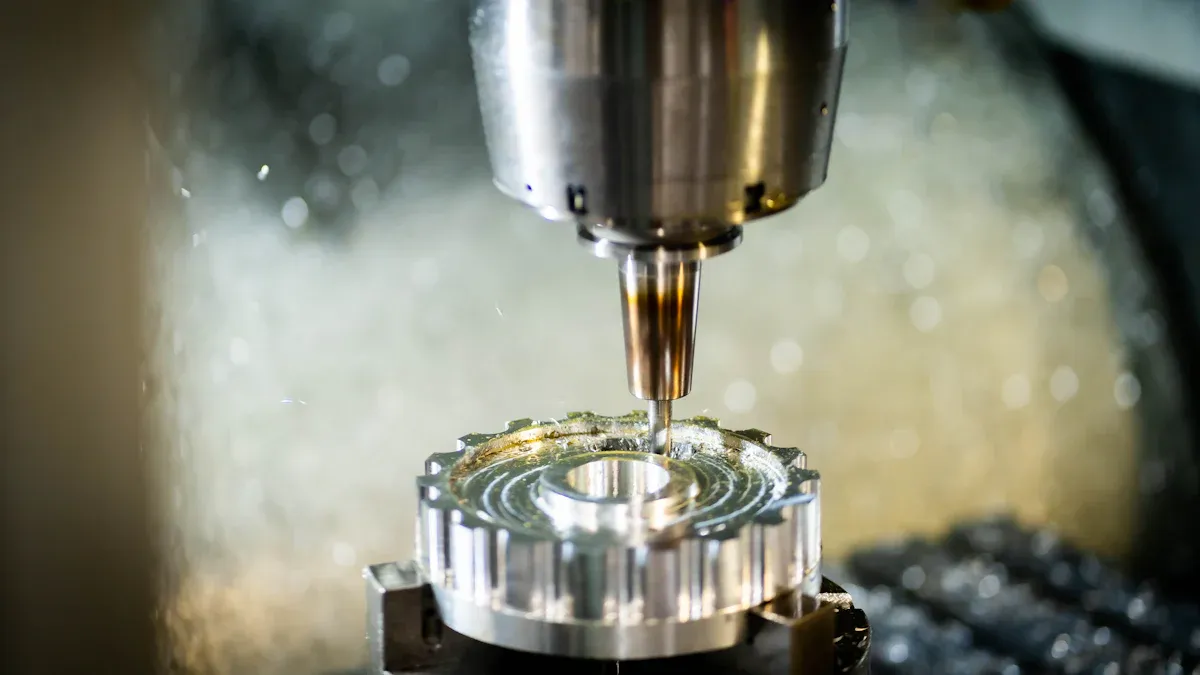
When you hear "vmc," you might not know what it is. A cnc vertical machining center is a machine that uses computer control to cut and shape things like metal or plastic. It is like a smart tool that helps you make parts very accurately.
A vmc works on flat pieces and makes holes or shapes by moving a cutting tool up and down.
The spindle is vertical, so it comes down from the top to reach the part.
You use modern cnc machining to control every step, so you get steady and exact results.
Vmc machines can drill, cut, and mill parts for many jobs, like cars or electronics.
These machines let you do tasks automatically, choose tools, and repeat jobs with the same quality each time.
You will see vmc machines in shops that need to make lots of parts fast. They are flexible and can do many different jobs. If you want to make holes or shapes in flat pieces, a vmc is a good pick.
Tip: If you are new, you will find vmc machines easier to learn than some other cnc machining centers.
Vmc machines are special because of their features. Here are some things you will notice:
The spindle points straight down, so you can see and reach the work area easily.
You can use a vmc for small test parts or big jobs.
The cutting tool spins fast and takes away material very exactly.
You get the same results every time because the machine repeats well.
Vmc machines cost less than some other types, so many shops buy them.
You can use them for many jobs, not just one thing.
Here is a table that shows how vertical machining centers compare to other cnc machines:
Feature | CNC Vertical Machining Center (VMC) | Other CNC Machines (e.g., HMC) |
|---|---|---|
Spindle Orientation | Vertically oriented | Horizontally oriented |
Operator Accessibility | Greater accessibility | Limited accessibility |
Cost Efficiency | More cost-effective investment | Generally higher investment |
Versatility | Excellent flexibility for multi-industry use | More specialized applications |
Precision | High precision and repeatability | Varies based on design |
You will see that vmc machines give you more access to the part. This makes setup and changes much easier. You can use a high-precision cnc vertical machining center for jobs that need tight fits. If you want to try advanced work, you can look for a cnc 4 axis machining center or even a cnc 5 axis machining center. These let you work on more sides of a part without moving it.
Cnc vertical machining centres are popular because they work for many needs. You can use them for simple drilling or for hard shapes. With cnc, you get fast, exact, and repeatable results. Vertical machine centers help you save time and money while making good parts.
If you want to start learning machining, a vmc is a great place to begin. You will learn the basics of cnc machining centers and see how computer control makes your work easier.
When you use a vmc, you control a powerful tool that shapes metal or plastic with high accuracy. The working principle of vertical machining centers starts with a strong frame. The machine has a vertical spindle that moves up and down. The worktable sits below the spindle and holds your part steady. You can move the table in different directions to help the cutting tool reach every spot.
Here’s a simple table to show you the main features of a vertical machining center:
Feature | Description |
|---|---|
Structure | The machine has a vertical spindle and a fixed column with a rectangular worktable. |
Movements | It usually has three linear movements. Some machines add a rotary table for spiral parts. |
Lubrication System | Compressed air pushes oil through tiny pumps and valves to keep parts moving smoothly. |
You will notice that the spindle comes straight down from above. This makes it easy to see your work and change tools. The machine uses a special lubrication system. Compressed air moves oil to important parts, so everything runs smoothly and lasts longer.
A vmc can move in three main directions. The table slides left and right, front and back, while the spindle moves up and down. Some vmc machines have a rotary table. This lets you make spiral shapes or work on more sides of a part without moving it by hand.
Tip: Always check the lubrication system before you start. Good lubrication keeps your vmc running well and helps you avoid costly repairs.
The heart of every vmc is the cnc control system. This system acts like the brain of the machine. You tell it what to do by entering a program. The cnc then moves the machine’s parts with great precision.
Let’s break down how the cnc control system manages movement:
Axis | Movement Description |
|---|---|
X-axis | Moves the table left and right, parallel to the work surface |
Y-axis | Moves the table front and back, perpendicular to the X- and Z-axes |
Z-axis | Moves the spindle up and down |
You control each axis separately. The X-axis slides the table left and right. The Y-axis moves it front to back. The Z-axis lifts the spindle up and down. Each axis uses a ball screw for smooth, accurate movement.
The Z-axis moves up and down.
The X-axis moves left to right and connects to the Y-axis.
The Y-axis moves front to rear.
Each axis works as its own unit, controlled by the cnc.
When you run a program, the cnc tells each axis where to go. The spindle spins at the right speed. The tool cuts the part exactly as you planned. This system lets you make complex shapes and repeat the same job many times with no mistakes.
A vmc uses a 3D coordinate system. You set the starting point, and the cnc moves the tool along the X, Y, and Z axes. This gives you full control over every cut. You can make holes, slots, or even detailed patterns. Vertical machining centers are famous for their accuracy and repeatability.
If you want to get started with cnc machining centers, learning how the control system works is key. You will soon see how easy it is to create parts that fit perfectly every time.
Note: The cnc control system helps you avoid errors and saves time. You can focus on design and let the machine handle the hard work.
When you look at a vmc, you see many parts working together. Each part helps you get accurate results and makes your job easier. Let’s break down the main components of a vertical machining center.
The spindle is the heart of your vmc. It spins the cutting tool and gives you the power to shape metal or plastic. You control the speed and power for each job. The spindle has several important parts:
Component | Function |
|---|---|
Drive system | Gives speed and power for your application. |
Spindle housing | Provides pressure, lubrication, and cooling. |
Bearing system | Keeps the spindle running smoothly and lasting longer. |
Shaft | Moves torque from the drive system and spins the spindle. |
Drawbar | Holds and releases the tool with the right force. |
You need a strong spindle for tough machining jobs. Good lubrication and cooling keep your spindle working well.
The table holds your workpiece steady while the vmc does its job. You can clamp your part in place and watch the cutting tool move. The table’s design affects how well your vmc performs.
Aspect | Impact on Performance and Versatility |
|---|---|
Flatness and Parallelism | Keeps your cuts accurate. |
Clamping and Positioning | Makes it easy to see and adjust the tool. |
Rigidity and Stability | Helps you get tight fits and smooth finishes. |
Range of Operations | Decides what jobs and materials you can handle. |
Stability and rigidity matter for precise machining.
The table lets you work with many shapes and sizes.
You don’t want to stop your vmc every time you need a new tool. The tool changer swaps tools fast so you can keep working. There are different types of tool changers:
Type of Tool Changer | Advantages | Disadvantages |
|---|---|---|
Gripping type ATC | Quick, reliable, low cost | Holds fewer tools |
Arm type ATC | Fast, works with many tapers, reliable | Takes up space, can jam |
Chain type ATC | Holds many tools, works with many tapers | Slow, expensive, needs space |
You pick the tool changer that fits your shop’s needs. Fast tool changes help you finish jobs quickly.
The control panel is your command center. You use it to run programs, set up tools, and check the machine’s status. Here are some keys and what they do:
Key | Function |
|---|---|
POS | Shows where the cutter is on the X, Y, Z axes. |
PROG | Lets you enter or view your program. |
OFFSET SETTING | Sets the tool’s starting point. |
INPUT | Lets you enter values for operations. |
HELP | Gives you tips and info about cnc. |
RESET | Stops a running program. |
You use the control panel to guide your cnc vertical machining center. It helps you avoid mistakes and keeps your vmc running smoothly.
Tip: Learn each part of your vmc. Knowing the components of a vertical machining center helps you get better results and solve problems fast.
When you use a vmc, you get very accurate results. These machines help you make parts that fit just right. You can trust a vmc to keep tight tolerances, even on hard jobs. Look at this table to see how exact a high-precision cnc vertical machining center can be:
Tolerance Level | Measurement |
|---|---|
Typical CNC Tolerance | ±0.005 millimeters |
High-end Machine Tolerance | ±0.002 millimeters |
Ultra-precision Tolerance | 1 to 5 microns |
You can see that vmc machines can reach tolerances as small as 1 to 5 microns. This means you can do high precision machining for parts that must fit together with no gaps. This level of accuracy is great for making lots of small, exact parts. You also save time because the machine works fast and repeats the same moves. You do not have to stop and check every part. The vmc keeps your work steady and your results the same each time.
Tip: If you want better performance and steady results, a vmc is a smart pick for precision milling.
A vmc can do many different jobs. You can use it for lots of tasks in manufacturing. If you need to make car parts or medical tools, a cnc vertical machining center can do it. Here are some ways you might use vertical machining centers:
Automotive: Make engine parts and transmission pieces.
Aerospace: Shape tricky parts for airplanes.
Medical: Make orthopedic implants and other devices.
Mold Making: Build injection molds and die-casting molds.
General Manufacturing: Create prototypes and custom parts.
You can switch from one job to another with just a few changes. The advantages of vmc machines include flexibility and easy setup. You can use a vmc for small batches or big runs. The machine gives you high precision and great performance every time.
If you want to try new projects or work with different materials, cnc vertical machining centres make it simple. You get the power of cnc and the flexibility to take on almost any job. That is why so many shops pick a vertical machining center for their work.
You might ask where vmc machines are used. They are found in many industries. These machines are fast, flexible, and very accurate. Here are some places where you will see vertical machining centers:
Aerospace: A vmc makes airframe parts and engine pieces. These need very careful machining.
Automotive: You can use a vmc to make engine parts, gears, and car accessories.
Electronics: Vertical machining centers help make device cases and circuit boards.
Medical and Healthcare: A vmc makes surgical tools and custom medical devices with high accuracy.
Defence: Vmc machines create parts for weapons and military vehicles.
Energy Sector: A vertical machining center builds parts for wind turbines and energy machines.
You can see that vertical machining centers are used in many fields. Each industry needs parts they can trust. A cnc vertical machining center gives good results every time.
Tip: If you want a job in a high-tech field, learning to use a vmc can help you a lot.
A vmc can make many kinds of parts. You can make simple or complex shapes. Here is a table that shows some parts you can make with different vmc machines:
Industry | Example Parts Made | Why Use a VMC? |
|---|---|---|
Aerospace | Brackets, housings, turbine blades | Needs accuracy and strength |
Automotive | Engine blocks, gearboxes, wheels | Fast production, tight fits |
Electronics | Housings, connectors, panels | Small size, fine details |
Medical | Implants, surgical tools | High precision machining |
Defence | Mounts, armor plates, frames | Complex shapes, durability |
Energy | Turbine hubs, pump parts | Large size, strong materials |
You can use a vmc for small or big parts. The cnc control lets you repeat jobs with no mistakes. This makes vmc machines great for making many matching parts.
Note: As technology gets better, vmc machines can do even more. You will always find new ways to use your vertical machining center.
When you look at a vertical machining center (VMC) and a horizontal machining center (HMC), you notice some big differences. The main one is the direction of the spindle. In a VMC, the spindle points straight down. In an HMC, the spindle sits sideways. This changes how you load parts and how the machine works.
Here’s a table to help you see the main design differences:
Feature | Vertical Machining Center (VMC) | Horizontal Machining Center (HMC) |
|---|---|---|
Initial Purchase Price | Typically lower | Higher |
Handling of Six-Sided Parts | Requires 7+ touches | Requires 3 touches |
Efficiency in Operations | Less efficient | More efficient |
Versatility | Less versatile | More versatile |
You might find that a VMC costs less to buy. It works well for simple jobs and smaller parts. An HMC can handle more sides of a part in fewer steps. This makes it faster for some jobs. HMCs also work better for complex shapes and bigger parts.
Tip: If you want to start with something simple and affordable, a VMC is a great choice.
Both VMCs and HMCs have good points and some drawbacks. You should think about what you need before you choose.
Feature | Vertical Machining Center (VMC) | Horizontal Machining Center (HMC) |
|---|---|---|
Cost | Less expensive, good for small shops | More expensive to buy and maintain |
Ease of Use | Easy to set up and reach your part | Setup is harder and needs more skill |
Chip Removal | Chips can pile up and hurt the finish | Chips fall away, so the finish looks better |
Workpiece Size | Best for small to medium parts | Handles bigger and heavier parts |
Production Efficiency | Great for short runs and testing | Makes more parts faster in one setup |
Automation Compatibility | Not as easy to automate | Works well with robots and pallet changers |
If you want a machine that is easy to use and costs less, you will like a VMC. You can see your work and change tools quickly. If you need to make lots of parts or work with big pieces, an HMC might fit better. It removes chips better and can run with less help from you.
️ Note: Think about your shop size, the parts you make, and how many you need. This helps you pick the right machine for your work.
When you want to pick the best vmc for your shop, you need to think about your parts and what you want to make. This step is key if you want to know how to choose the right machining center for your needs. Let’s break it down so you can make a smart choice.
Start by looking at the size of the parts you plan to make. If your workpieces are large, you need a vmc with a big enough table and long travel distances. This way, your parts fit on the machine without trouble. The material you use matters too. Some vmc machines work better with soft materials like aluminum, while others handle tough metals like steel. Each material needs the right spindle speed, power, and machine strength. If you want to cut plastics, you might not need as much power, but for steel, you need a strong and rigid vmc.
Tip: Always check the biggest part you want to make and the hardest material you plan to cut before you buy a vmc.
Think about the jobs you want your vmc to do. These machines can handle many tasks, such as:
Drilling
Tapping
Milling
Prototyping
Multi-axis machining
Some vmc machines come with extra features for special jobs. If you want to do more than basic cuts, look for a vmc with advanced options. You should also check the machine’s specs. Here’s a quick table to help you compare:
Specification Type | Description |
|---|---|
Spindle Speed | Affects what materials you can cut and how fast. |
Travel Range | Decides the biggest part you can fit. |
Rigidity | Helps keep your cuts accurate. |
Stability | Makes sure your parts come out right every time. |
Control Systems | Makes the vmc easy to use and program. |
Modern vmc machines often have smart features like automation and real-time monitoring. These can help you work faster and keep your quality high.
Note: Good support matters too. Many vmc makers offer training, service, and help with maintenance. This support can save you time and money as you learn to use your new cnc.
When you start setting up and operating a vmc machine, you want to follow a clear process. First, check that your vmc is clean and free of leftover chips. Place your workpiece on the table and clamp it tightly. Make sure the clamps do not block the tool path. Next, load the right tool into the spindle. Double-check the tool number and type. Set your work offsets and tool heights. This step helps you avoid crashes and keeps your machining accurate. Enter your cnc program and review it for errors. Run a dry cycle with no cutting to watch the machine’s movements. If everything looks good, you can start your first cut.
Tip: Always use a checklist when you set up your vmc. This habit helps you catch small mistakes before they become big problems.
Safety matters every time you use a vmc. You need to protect yourself and others in the shop. Here are some key safety tips:
Get proper training before you use a vmc.
Keep long hair tied back and avoid loose clothing.
Never wear gloves near moving parts.
Use more automation to keep your hands away from dangerous areas.
Always shut down the vmc before maintenance or tool changes.
Many beginners make mistakes that can cause damage or injury. Watch out for these common errors:
Setting offsets wrong can crash the vmc.
Picking the wrong tool can scratch or ruin your part.
Forgetting to set cutter heights can hurt your precision.
Not knowing enough about G-code can lead to programming mistakes.
Skipping maintenance can cause overheating and poor results.
Note: Stay alert and never rush when you work with a vmc. Safety comes first.
Good maintenance keeps your vmc running smoothly. You should schedule regular checks to prevent breakdowns. Use a checklist for daily and weekly tasks. Clean the work area to stop chips and dust from causing wear. Watch your tools for signs of wear and replace them as needed. Pick quality parts and tools for better performance. Always monitor the bearings and lubrication system. This care helps your vmc last longer and keeps your machining accurate.
Tip: A clean and well-maintained vmc saves you time and money in the long run.
You now know the basics of a cnc vertical machining center. Here are the main things to remember: The machine has a strong base, a spindle that goes up and down, and a table that moves. It can do milling, drilling, and tapping with great accuracy. The computer helps you work with many shapes and materials.
Are you ready to learn more? Try these steps: Practice setting up the machine and doing safety checks. Look for beginner training programs:
Program Name | Institution | Description |
|---|---|---|
CNC Machining Short-Term Training Program | Hawkeye Community College | Learn how to set up, use, and check the machine. |
Basics of CNC Programming & Machining | Simon Fraser University | Start learning CNC skills from the beginning. |
Keep learning new things, ask questions when you need help, and try out new projects. You can get good at cnc if you keep practicing and stay curious!
CNC means Computer Numerical Control. You use a computer to tell the machine what to do. The computer follows your program and moves the tools to cut or shape your part.
You can learn the basics quickly. Many people start with simple projects. Practice helps you get better. Training programs and online videos make learning easier. Don’t worry if you make mistakes at first.
Yes! You can use a VMC for metals, plastics, and even wood. Just pick the right tool and settings for each material. Always check the machine’s limits before you start.
Clean your machine every day. Check the oil and lubrication. Replace worn tools. Follow the maintenance schedule in your manual. Good care keeps your VMC running smoothly and safely.
You should wear safety glasses and closed-toe shoes. Tie back long hair. Avoid loose clothing. Ear protection helps if the shop is loud. Always follow your shop’s safety rules.


